
Amplify
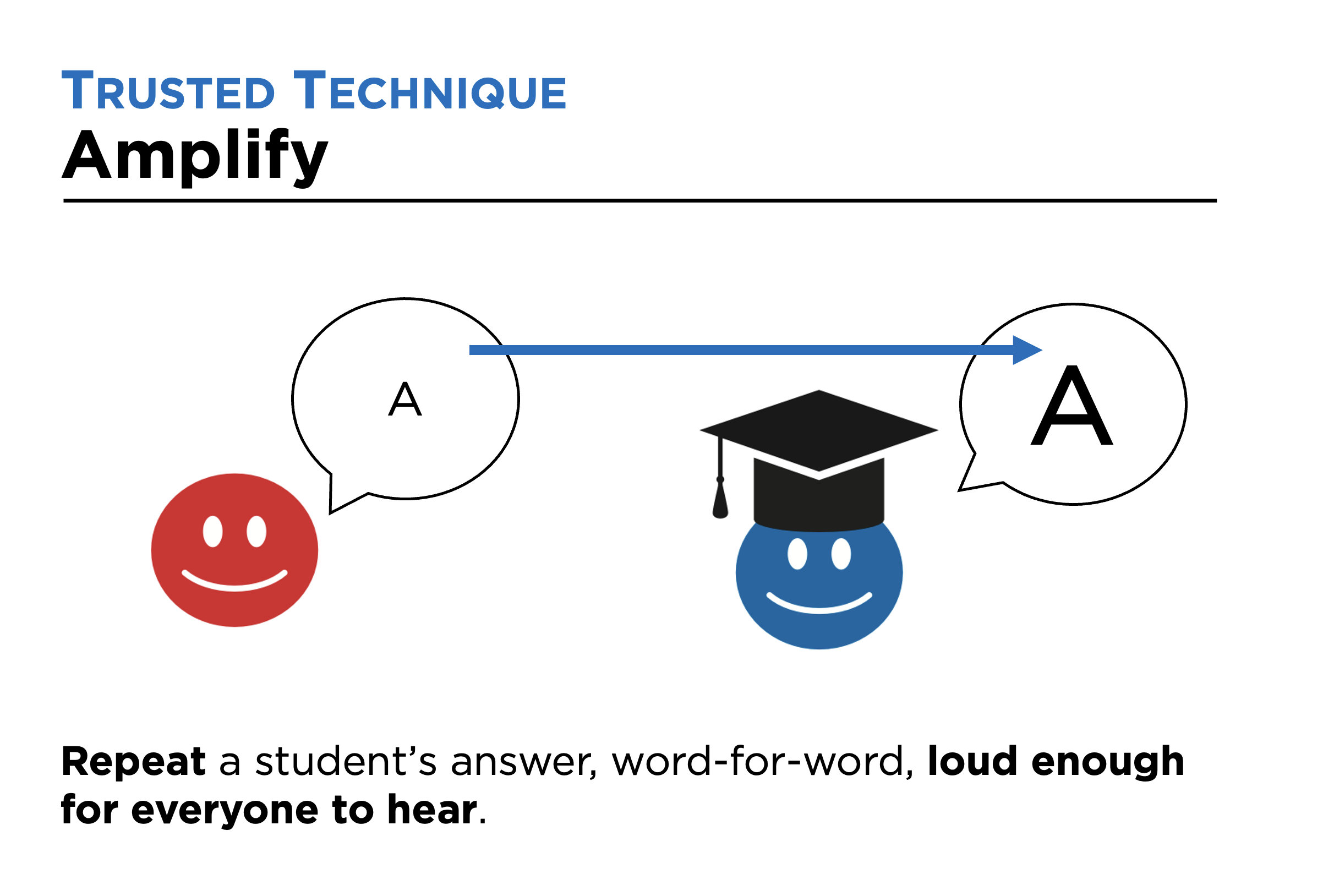
A student’s answer to a question is too quiet for everyone to hear, so you repeat back what they have said, word for word - without paraphrasing - so everyone can hear. In other words, you Amplify the student’s response.
Why use this technique?
This technique helps support the development of a ‘listening culture’ in classrooms: every student is supported and encouraged to listen to what every other student is saying.
A common barrier to the development of this culture is when students’ answers to questions are too quiet for everyone else to hear. Amplifycan help address that. Used over time, the technique should become redundant, because students learn to always answer loudly enough.
Example
In a business management lesson…
Teacher: ‘Let’s recap what we should have learned about stakeholders to this point. Can I have one way in which a stakeholder can influence a business, please… Oliver.’
Oliver: [Quietly.] ‘They can withdraw equity.’
Teacher: ‘They can withdraw equity. What do you think… Kate? Is he right?’ [The teacher has amplified the answer.]
Kate: ‘Yes, I think he is.’
Teacher: ‘Agreed. One of the things stakeholders can do to influence a business is withdraw equity. Can you add anything to this, Kate?’ [The teacher has amplified the answer again.]
Kate: [Quietly.] ‘They can also invest equity.’
Teacher: ‘That’s a good answer. They can invest equity too.’ [Again, the teacher has amplified the answer.]
Notes and tips
If, when amplifying, you change any words from the original answer, make sure you draw attention to this, so everyone is clear about the change you made. For example, in an art lesson, if you have asked a student what type of painting they are looking at and they answer, ‘A portrait’, don’t amplify by saying, ‘Yes, it’s a self-portrait’, because that isn’t the answer the student gave.
Focused reflection
How well do you currently use this technique?
Is it a technique you will focus on developing?
If so, what are the key features you will focus on (things to do, and not do)?