
Chat To A Partner
AKA: Turn and Talk
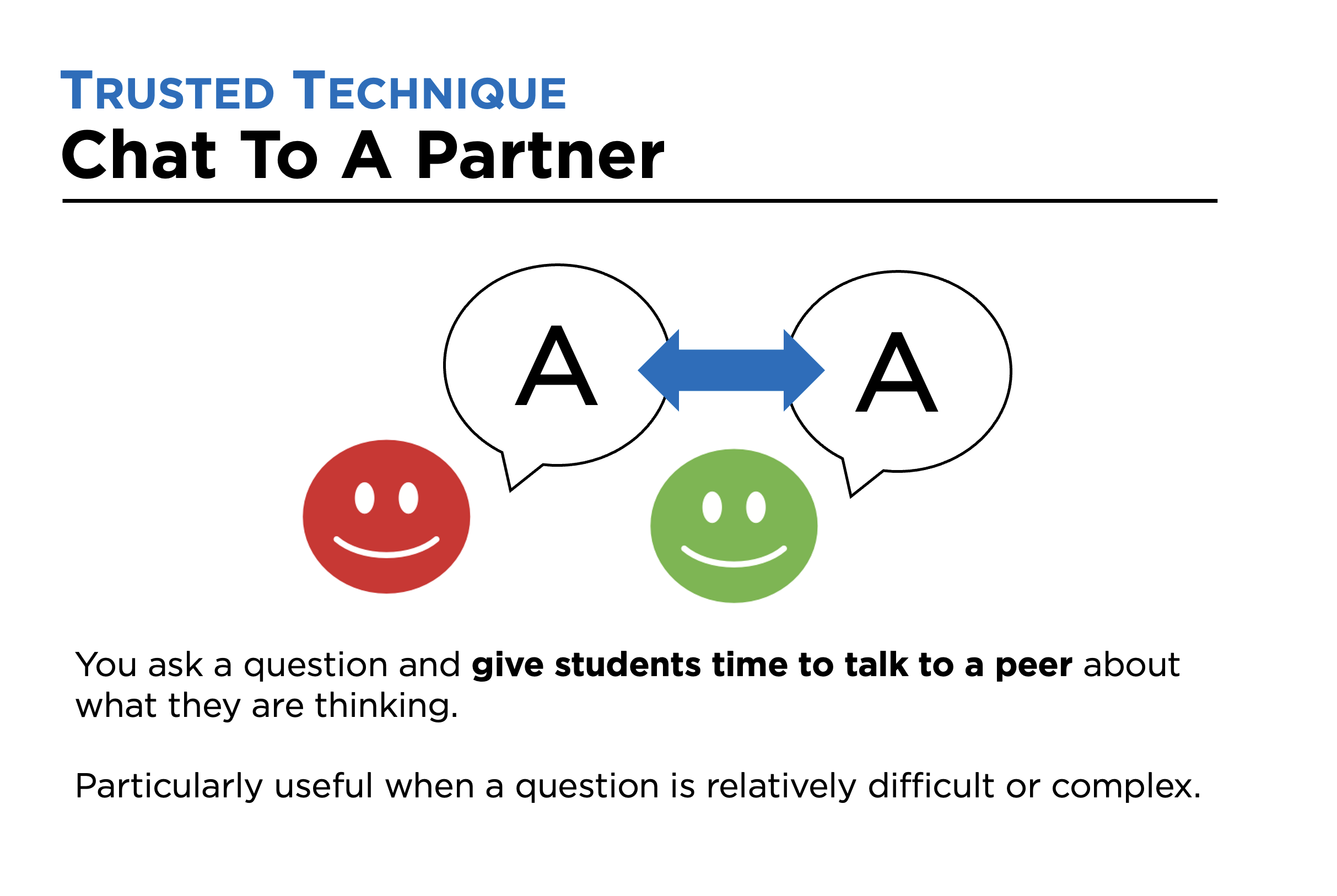
With the technique Chat To A Partner, you ask a question and give students time to talk to a peer about what they are thinking. For example, you might say:
“Take 30 seconds and chat to a partner.”
“2 minutes - chat to a partner.”
Why use this technique?
By giving students time to talk, you are also giving them time to think. More than this, you are giving students the opportunity to check their thinking with another student. This can build confidence and increase their willingness to share their answer with the rest of the class. By articulating their thoughts, it can also help them to refine these and uncover the true depth of their understanding.
If you listen in to some of the conversations going on, you can glean formative information about what students know and don’t know. You can then respond to this at an appropriate time, such as when you address the class. For example, you might say, ‘I heard lots of good discussion there. One thing that I did pick up was that a lot of you were saying [this], but that’s not quite right...’
Example
In a physics lesson…
Teacher: ‘What do you remember about series and parallel circuits from the past three lessons? Take two minutes and chat to a partner.’
Students chat and the teacher circulates the room, listening to conversations.
Teacher: ‘Okay, let’s stop there. [Waits for silence and full attention.] I heard lots of interesting points being discussed. Could you tell us what you and your partner were discussing, please… Wesley?’
Wesley: ‘We said that series circuits just have one route, but parallel circuits can have more than one.’
Teacher: ‘Thanks, Wesley. I actually heard quite a few pairs use the word “route”. Gael and Laraine, I think you used a better word. What was it, please, Laraine?’
Laraine: ‘It was branches.’
Teacher: ‘Right. So, series circuits just have one branch but parallel circuits can have more than one. Let’s make sure we all use the word “branch” next time.’
Notes and tips
Chat to a Partner can be particularly useful when you are asking an open question that doesn’t necessarily have a definitive correct answer. For example, when you want to find out:
What students already know about something at the start of a lesson or topic.
What students can remember from a previous lesson.
What students have understood from a particular section of the current lesson.
What students’ opinions or beliefs are about something.
Challenging or complex questions
It is also a useful technique if you want students to think about something that is particularly challenging or complex. Effectively, the technique creates an imaginary safety net for getting things wrong. Students are usually less bothered about getting something wrong in front of the class if they have had a chance to talk to a partner first. Instead of saying, ‘I think…’, they can say, ‘We think…’
Link to circulating the room
As well as helping you glean formative information about what students know or don’t know, circulating the room during paired discussion should help to keep students on task with what they are discussing. As you circulate the room, it can be useful to have a small notepad to hand so you can jot down key points. With the best will in the world, it can be difficult to remember all of these (even if you think you will).
Focused reflection
How well do you currently use this technique?
Is it a technique you will focus on developing?
If so, what are the key features you will focus on (things to do, and not do)?