
Chart It
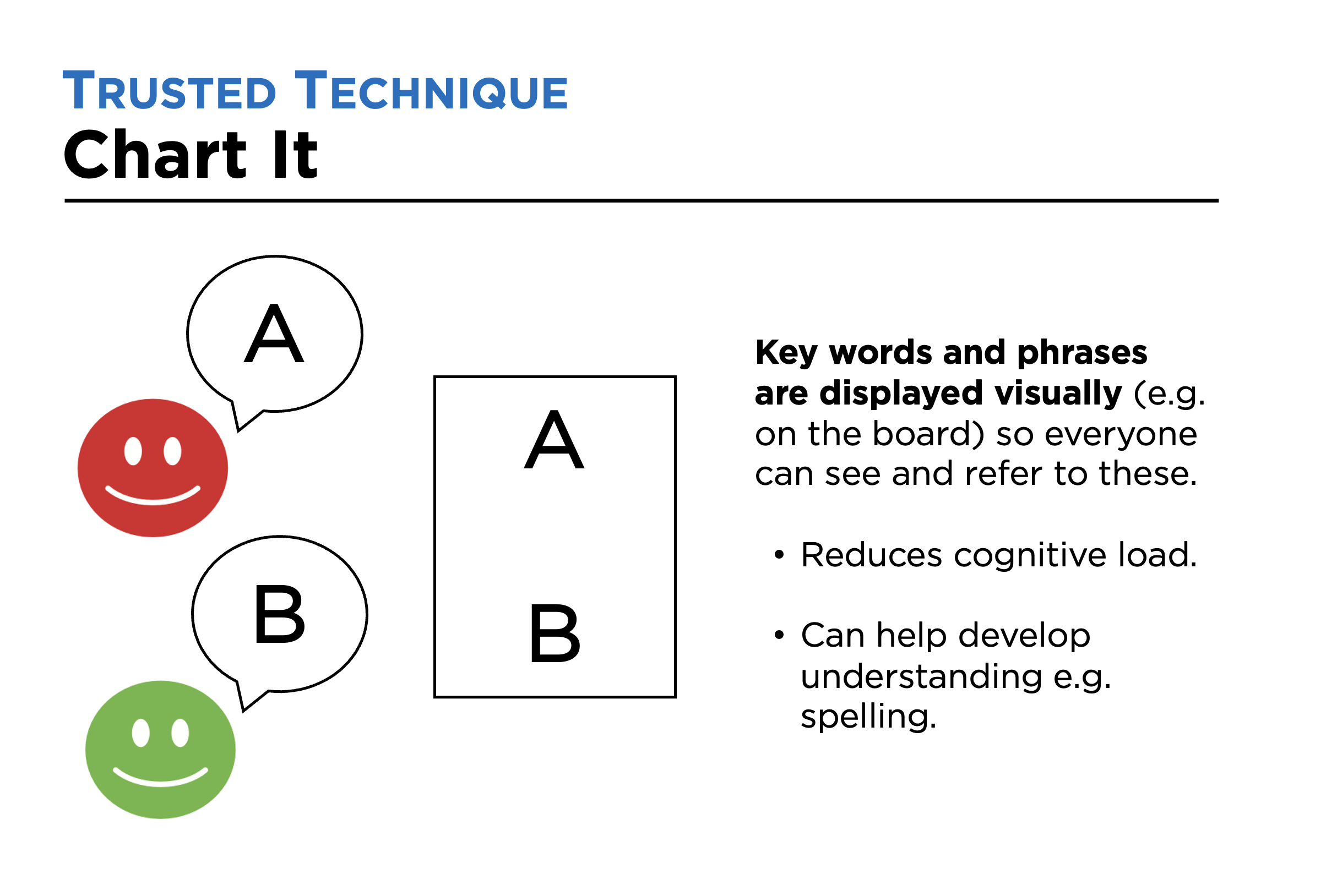
With the technique Chart It, key words and phrases from a student’s answer are written onto the board for everyone to see and refer back to.
Why use this technique?
There is a limit to how much information students can hold in their working memories. This can be a particular problem when a class is learning new things with unfamiliar terminology or when multiple points are getting made during the course of whole-class discussion. Writing key words and phrases on the board leaves more space for thinking in working memory.
Another reason the technique can be useful is because students sometimes mishear or misinterpret the answers other students have given. For example, someone might say ‘euthanasia’, which someone else might hear as ‘youth in Asia’. Writing what was said on the board helps avoid such misunderstandings.
Also, spelling matters. By writing key words and phrases on the board, students can see what these look like and how they are spelt.
Example
In a science lesson…
Teacher: ‘Today we are going to start a new topic on genetics. I’m wondering what you know about genetics already. Would anyone like to share what they know?’
The teacher pauses for 20 seconds, scanning the room and waiting for more and more hands to go up.
Teacher: ‘Maer, why don’t you start us off.’
Maer: ‘Genetics is to do with the genes that we have in our bodies.’
Teacher: ‘Okay, that’s a nice start. Genes is a key word.’
The teacher writes ‘genes’ onto the board.
Teacher: ‘So notice, everyone, that “genes” starts with a G, not a J. It’s not like the spelling we use for clothes. Okay, who’s next? Martin.’
Martin: ‘Genes are made up of DNA.’
Teacher: ‘That’s good.’
The teacher writes ‘DNA’ on the board.
Teacher: ‘When we write “DNA”, we should always use capital letters.’
The questions, answers and charting continue.
Focused reflection
How well do you currently use this technique?
Is it a technique you will focus on developing?
If so, what are the key features you will focus on (things to do, and not do)?