
Difficulty Staircase
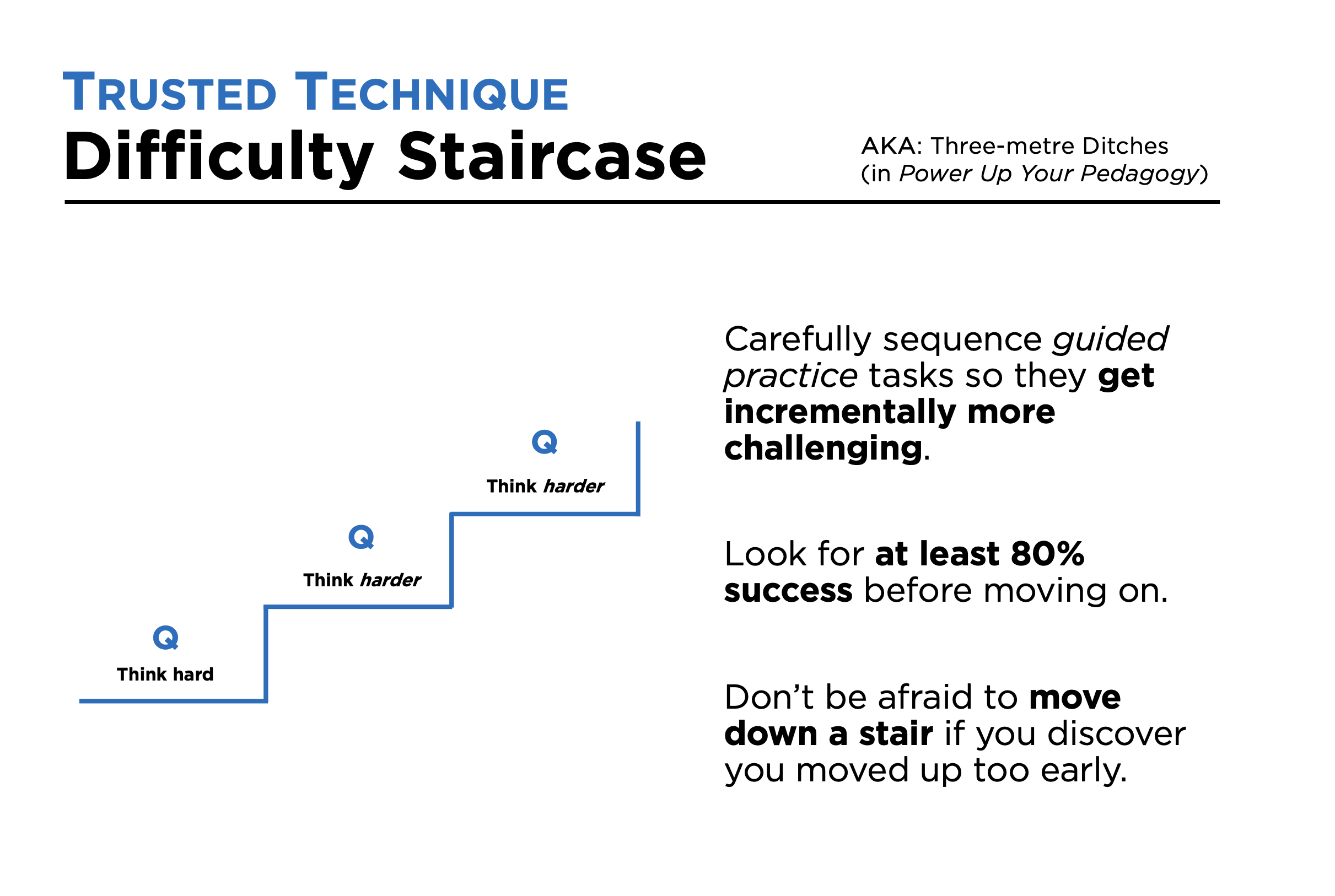
With the technique Difficulty Staircase, guided practice tasks are carefully sequenced to get incrementally more challenging.
The first task is deliberately straightforward and helps to build motivation through the experience of success. The next task is a bit more difficult, the next task more difficult again, and so on.
The teacher monitors the performance of the class with each task and bases the decision to move up a stair or not on whether they have evidence that at least 80% of the class have been successful on the current stair.
Should they realise they have moved up a stair too quickly, they take a step back and ask students to re-practise more of a less challenging task, before moving up a stair again.
Why use this technique?
Asking students multiple questions about the same content should get them to think about this more than they would have if only one question was asked. As questions get more challenging, students will be required to think harder. This will help develop knowledge connections and strengthen memory. The more questions you ask, the more detail you get about the depth of students’ understanding. The success of answering questions that get progressively more challenging should be motivating to students, producing a sense of accomplishment and keeping them interested.
Examples
In English…
Step 1: Write the definition of an adjective.
Step 2: Identify the adjectives in these two sentences.
Step 3: Write a sentence with two adjectives, underlining them both.
In biology…
Step 1: Choose the correct definition for hormones from the following list.
Step 2: Choose which of the following fit this definition: insulin, dopamine, lipase, pepsin, bile.
Step 3: Name at least two further examples of hormones.
Notes and tips
Decisions about when to move up (or down) a step can be guided by an ‘80% success rule’: look for evidence of success from at least 80% of students before moving to the next step.
The 80% Success Rule doesn’t mean you ignore the 20% of students who can’t answer or have answered incorrectly. By giving feedback on each stair, you should be addressing some of the issues these students had. For the small number of students who continue to struggle despite this feedback, you should make time later in the lesson to do some one-to-one or small-group teaching while others in the class work on consolidation or extension material.
Be careful not to increase the level of challenge too far, too quickly. If the steps are too big, students won’t be able to climb them. Also, don’t be afraid to ‘ham up’ the difficulty a question poses. For example, you might say, ‘The next question is a really challenging one. I’m going to be so impressed if everyone can get this one right!’ This should increase students’ sense of accomplishment.
Because it can be difficult to ‘plan a staircase’ in the moment, it is usually best to plan Difficulty Staircase tasks in advance of a lesson, individually or – even better – with a colleague.
Focused reflection
How well do you currently use this technique?
Is it a technique you will focus on developing?
If so, what are the key features you will focus on (things to do, and not do)?