
Key Features
When you use the technique, Key Features, success criteria highlight the specific things you want to see or hear in a piece of work or a performance.
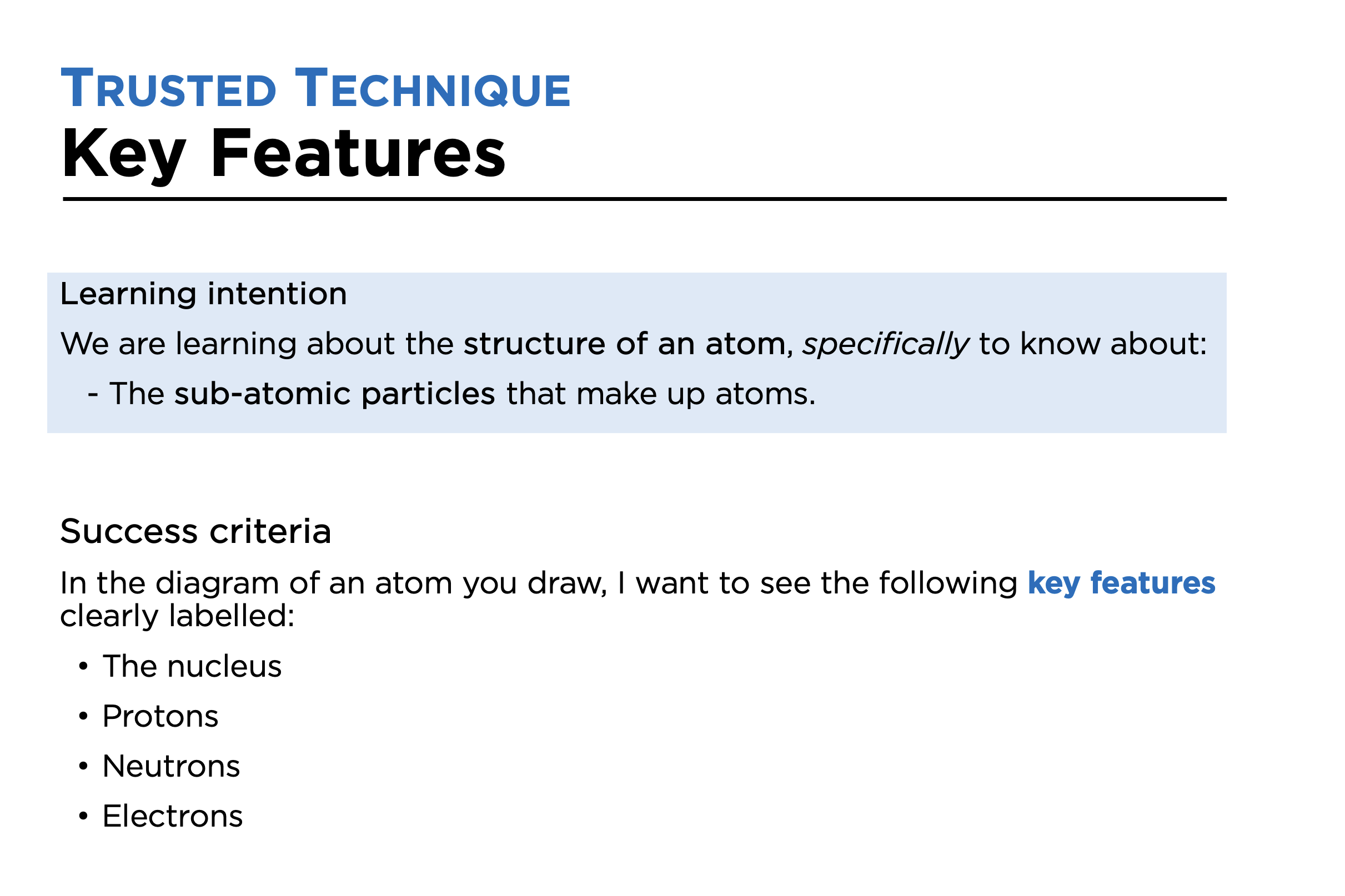
For example, if a learning intention reads, ‘We are learning about the structure of an atom, specifically, to know about the sub-atomic particles that make up atoms’, success criteria as Key Features might be:
In your diagram, I want to see the following clearly labelled:
The nucleus
Protons
Neutrons
Electrons
Why use this technique?
When teachers think of success criteria, they often default to ‘I Can…’ Statements. Sometimes, ‘I Can…’ Statements are the best type of success criteria to use. Other times, it is more useful to use Key Features. This is often when learning intention statements relate to procedural knowledge and include ‘be able to…’ in their wording.
Examples
In a maths lesson with the learning intention, ‘Be able to calculate the area of a circle, showing clear working’…
When you are completing these calculations, I want to see the following features in your working:
Formula
Substitution
Answer
Units
In a PE lesson with the learning intention, ‘Be able to swim front crawl with an efficient leg kick’…
When doing this, your:
Legs will be straight and toes pointed
Legs will reach a depth of approximately 18 inches and will only create a bubble at the surface
Legs will pass close together
Body position will be flat and will not rotate
In a science lesson with the learning intention, ‘Be able to present data in a table’…
The key features of this are that:
It has two columns
Each column has an appropriate heading
Each heading has correct units
The data has been entered correctly
It has been drawn with a ruler
Focused reflection
How well do you currently use this technique?
Is it a technique you will focus on developing?
If so, what are the key features you will focus on (things to do, and not do)?