
On The Hook
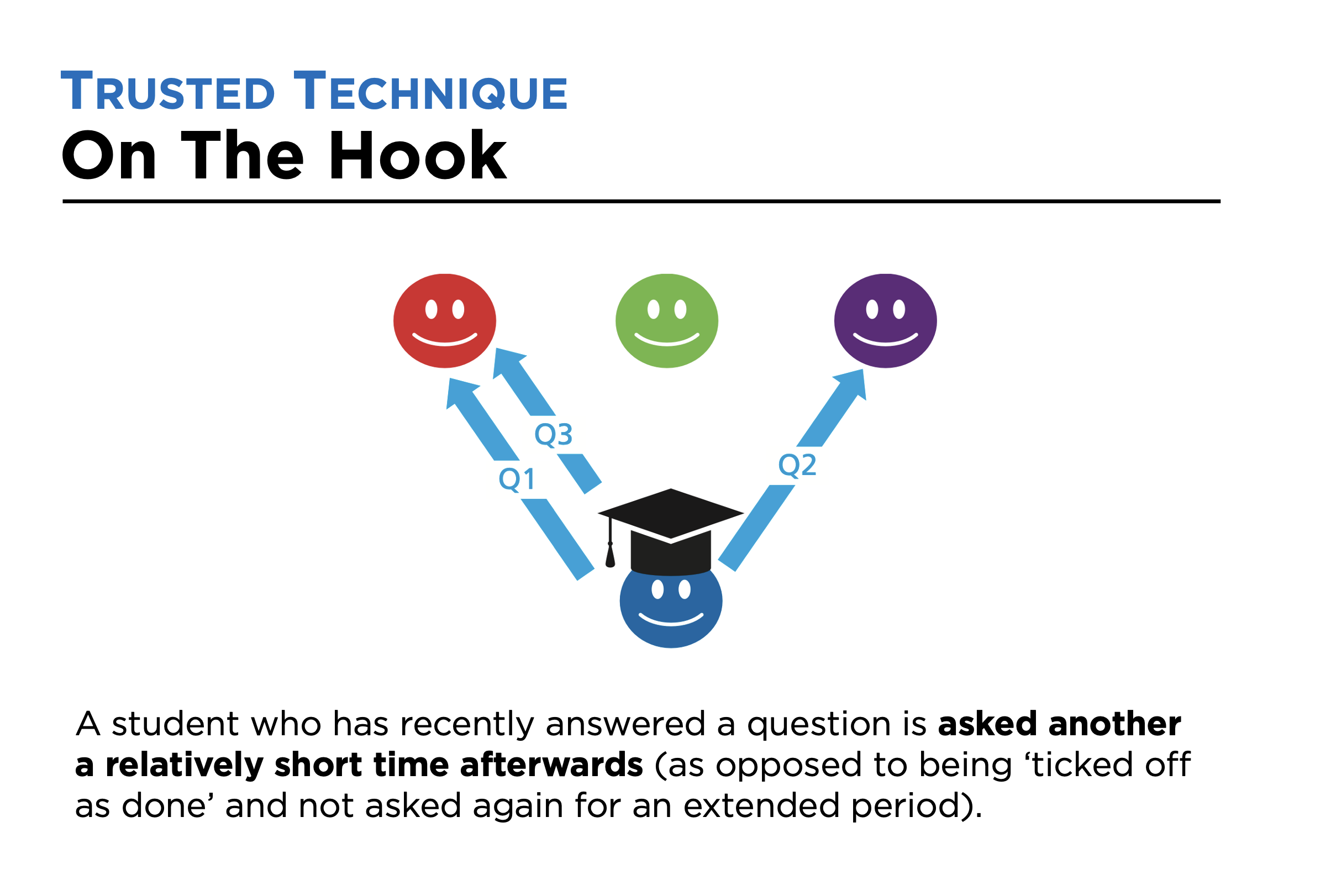
With the technique On The Hook, a student who has recently answered a question is asked another a relatively short time afterwards (as opposed to being ‘ticked off as done’ and not asked again for an extended period).
Why use this technique?
If students believe you are ‘working your way around the class’, they can switch off once their turn has passed. For example, if there are 30 students in the room, a student who has just been asked a question might believe that the other 29 are going to be asked before they will be again. This technique helps prevent that and hold students’ attention.
Example
In a science lesson…
Teacher: ‘Which gas is the most abundant in the Earth’s atmosphere... [pause]… Kirsty?’
Kirsty: ‘Nitrogen.’
Teacher: ‘Good. Which is the second most abundant gas… Scott?’
Scott: ‘Oxygen.’
Teacher: ‘Well done. How much of our atmosphere is made up of oxygen… Laura?’
Laura: ‘About 20%.’
Teacher: ‘Good. And what percentage is nitrogen… Kirsty?’ [Kirsty is being kept On the Hook.]
Kirsty: ‘Um… I don’t know.’
Teacher: [In a warm tone.] ‘Did you hear the question?’
Kirsty: ‘No. Sorry.’
Teacher: [Again, in a warm tone.] ‘Okay, well make sure you keep listening. What percentage of the Earth’s atmosphere is nitrogen?’
Kirsty: ‘Just under 80%.’
Teacher: ‘Well done.’
Notes and tips
Ultimately, we want all students to feel like they are always on the hook. In other words, we want them to understand that anyone could be asked a question at any time, so it is important that everyone keeps paying attention.
To use the technique effectively, you usually need to make a mental note about who is answering questions. If you find this difficult, make a physical note. For example, you could write things on your class seating plan.
Focused reflection
How well do you currently use this technique?
Is it a technique you will focus on developing?
If so, what are the key features you will focus on (things to do, and not do)?