
Success Criterion Check-In
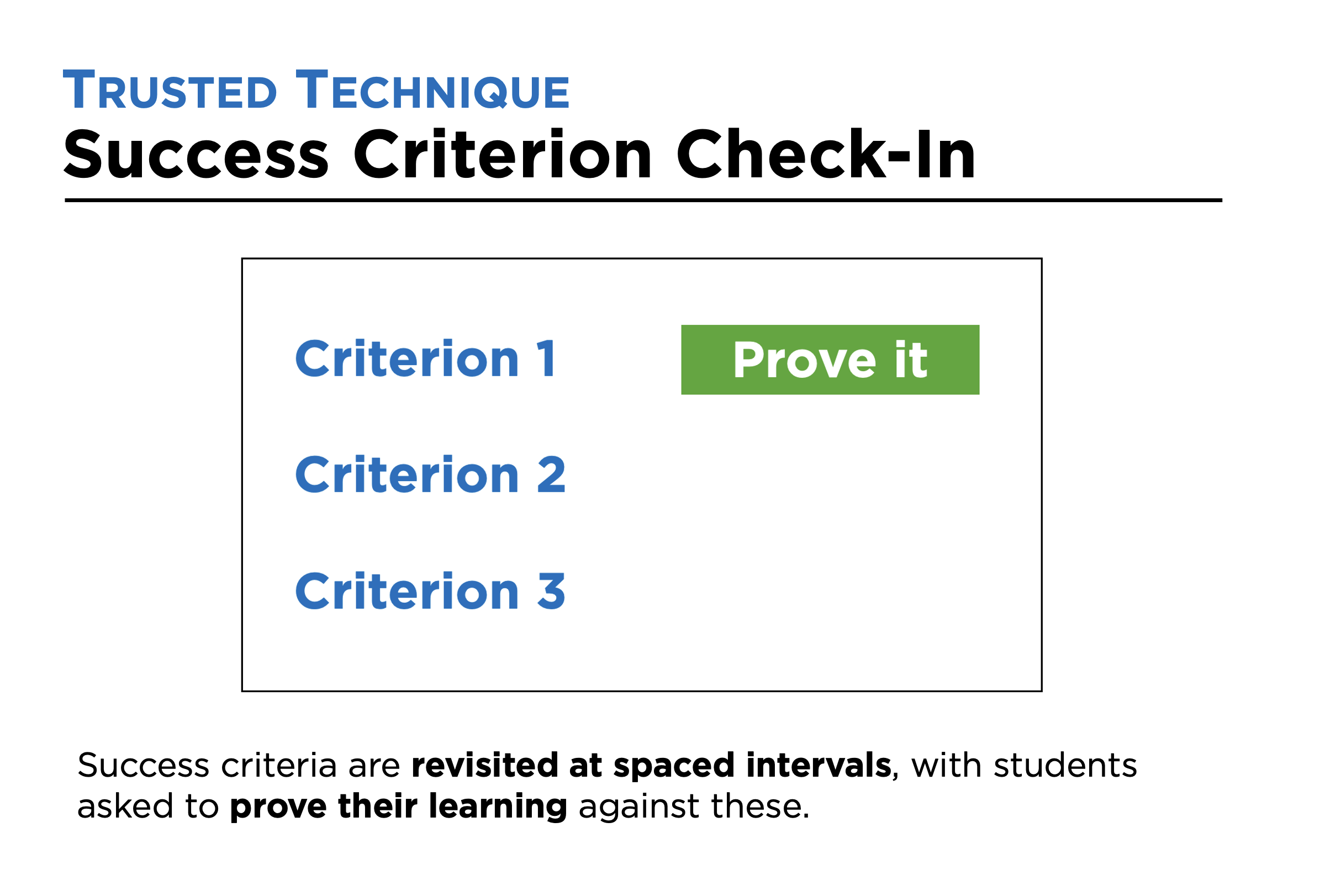
The technique Success Criterion Check-In can be used when a lesson has ‘I Can…’ success criteria.
At planned points in a lesson, students are reminded what the success criteria are and asked to complete a short task that checks short-term learning relating to one of these.
Why use this technique?
Revisiting success criteria can help remind students (and you) what they are trying to achieve in a lesson. Students’ performance in the Success Criterion Check-In task generates evidence about the size of the teaching–learning gap, so you can respond accordingly. By generating evidence, students should have a better idea of what they actually know and can do, as opposed to what they believe to be true. Beyond of all of these reasons, this technique requires retrieval, which strengthens memory, and can help break up periods of teacher exposition, helping hold students’ attention and interest.
Example
For example, a history lesson might have two success criteria:
I can give at least two reasons why the Greeks created myths and legends.
I can outline at least three key events in the story of Atlantis.
The teacher shares these with students towards the start of the lesson. They then move into an interactive PowerPoint presentation. Midway through this, a slide appears with the heading ‘Success criterion check-in’.
The first criterion is highlighted, and the teacher asks students to use Show-me Boards to prove they can do this. Looking at boards, the teacher can see that most students can, but a few can’t. The teacher summarises correct answers and makes it clear that this criterion is going to be revisited again at the end of the lesson and that they will be looking for all students to be able to meet it.
In the final five minutes of the lesson, the teacher again revisits the success criteria with students. They ask two questions, each relating to a different criterion. Students are asked to write answers on Show-me Boards, which the teacher looks at. They use what they are seeing to guide their planning for the next lesson.
Focused reflection
How well do you currently use this technique?
Is it a technique you will focus on developing?
If so, what are the key features you will focus on (things to do, and not do)?