
Bounce
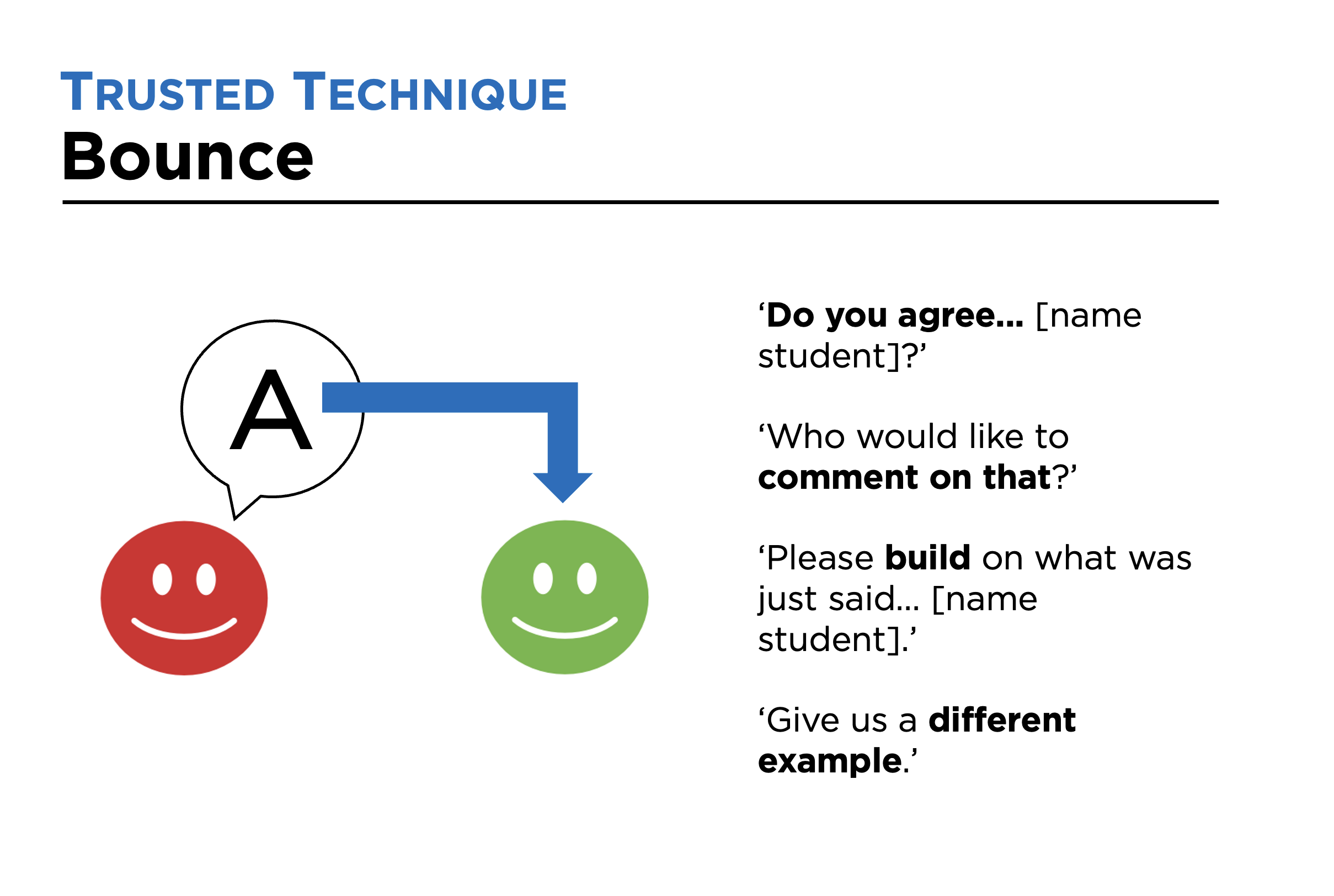
With the technique Bounce, after a student has answered a question, you ask a different student to comment or build on the answer given.
For example, you might say:
‘Do you agree... [name student]?’
‘What do you think about what was just said... [name student]?’
‘Who would like to comment on that?’
‘Please could you build on what was just said... [name student].’
Why use the technique?
Bounce helps ensure that everyone is listening to all answers. By doing so, it helps establish a collaborative learning environment in which students understand they are expected to learn with and from one another, not just the teacher. Sometimes, students can pick up on things in other students’ answers that we might have missed.
This technique can also help students clarify their thinking. For example, if a student has commented on the answer given by another student, the student who gave the original answer might come back and say, ‘No, that’s not what I meant to say. What I meant to say was…’
Example
In an English lesson…
Teacher: ‘Can you give us an example of a simile, please… [pause] …Erin?’
Erin: ‘As light as a feather.’
Teacher: ‘Thanks, Erin. Is she right… Charlie?’ [Bounce]
Charlie: ‘Yes.’
Teacher: ‘Why is that?’
Charlie: ‘Because a simile is when we use “like” or “as” in a sentence.’
Teacher: ‘What do you think about that… Fiona?’ [Bounce]
Fiona: ‘I don’t think that’s quite right. I think the sentence has to be comparing things to be a simile.’
Teacher: ‘Okay, that’s interesting. Can you comment on that, please… James?’ [Bounce]
James: ‘Yes, I think that’s right. Because if I said “I like cows”, that wouldn’t be a simile.’
Teacher: ‘Good example. Okay, so back to you, Charlie. Could you tell us what a simile is, please?’ [Bounce]
Charlie: ‘It’s when we compare things using “like” or “as”.’
Focused reflection
How well do you currently use this technique?
Is it a technique you will focus on developing?
If so, what are the key features you will focus on (things to do, and not do)?