
Choral Response
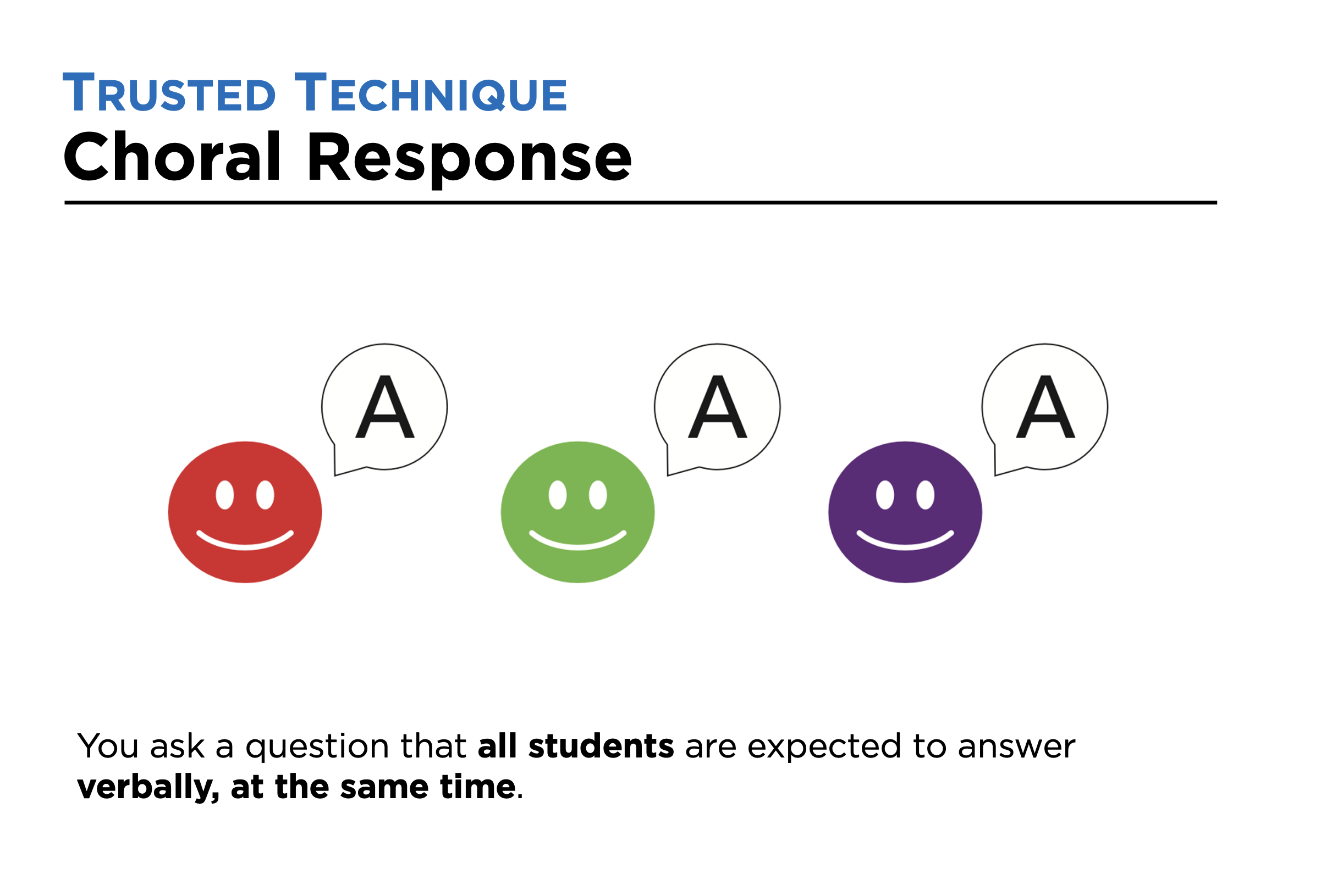
With the technique Choral Response, you ask a question that all students are expected to answer verbally at the same time.
Why use this technique?
This technique gets all students to participate actively (i.e. to think) and addresses the issue of some students choosing to be passive in their learning. In doing so, it helps hold attention. Effectively, it’s a form of verbal show-me board.
Example
In an English language lesson with the words ‘noun’, ‘verb’ and ‘adjective’ written on the board as the three options for students to choose from…
Teacher: ‘In the sentence “Greg suddenly hit the ball”, which word is the verb? Everyone, together.’
The teacher listens and scans the room as 25 students answer in unison. They note that two students don’t answer and that there were at least four incorrect answers.
Teacher: ‘That wasn’t bad, but I heard a few incorrect answers, and I saw two of you who didn’t say anything. The correct answer is “hit” because this tells us what Greg was doing. Remember: verbs are doing words. Let’s try another example together. I’ll be looking for 100% participation this time.’
Notes and tips
Used well, Choral Response can help to bring about ‘three Es’ of great teaching: engagement, energy and enthusiasm. As well as encouraging all students to participate actively, the technique helps ensure all students experience success and feel they are a part of a shared learning community, with everyone’s learning being important and moving forward together.
When using the technique, you should scan the room and check everyone is participating. If that isn’t the case, you might say something like, “That was pretty good, but I’d like to see everyone participating this time. Let’s go again.”
If you are drawing attention to participation levels that are below 100%, as far as possible, try to avoid singling out particular students who aren’t participating. For example, don’t say: ‘I saw everyone participating except Jamie.’ That’s not going to make Jamie feel good. Instead, try to use generic phrases, such as ‘Let’s have another go with everyone participating this time.’ If you need to, you can have a quiet word with Jamie later.
Focused reflection
How well do you currently use this technique?
Is it a technique you will focus on developing?
If so, what are the key features you will focus on (things to do, and not do)?