
Chunk It
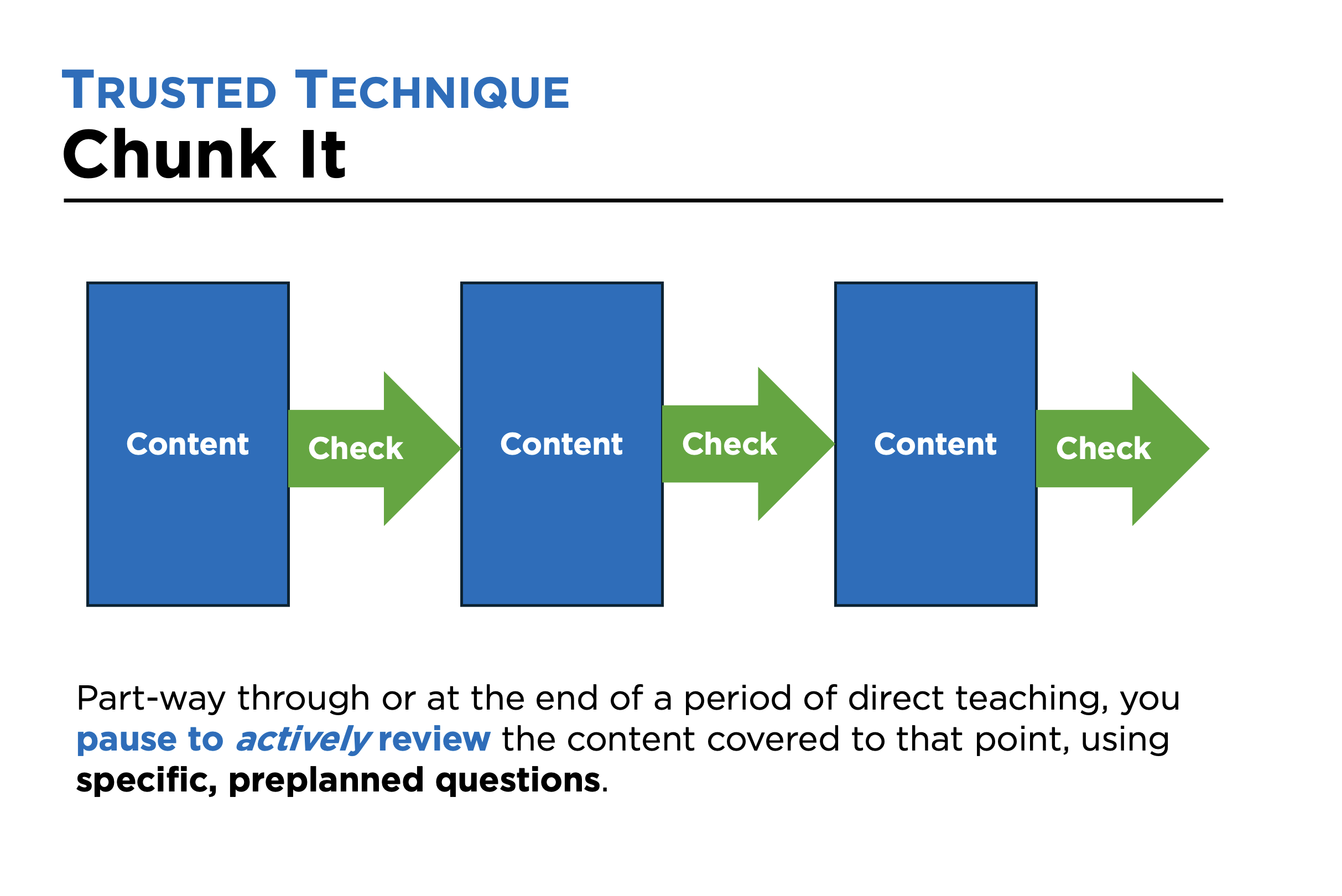
With the technique Chunk It, you deliberately break up your exposition with short, pre-planned tasks that require students to ‘do something’ with the information presented.
Why use this technique?
As well as being a good way to check understanding, the break in teacher exposition can be a useful way to hold attention. The technique also requires retrieval (knowledge recall from long-term memory), which helps strengthen learning.
Example
In a history lesson as part of a series about conflict and tension between the East and the West, 1945–1972…
The teacher has been delivering an interactive presentation to the class. Fifteen minutes in, a slide appears with the heading ‘Checkpoint time’ and three preplanned questions:
Which two countries were regarded as the global ‘superpowers’ at this time?
Which of these two was communist and which was capitalist?
What do the terms ‘communist’ and ‘capitalist’ mean?
The teacher tells the class that they want everyone to answer the first question on Show-Me Boards. On seeing students’ answers, they give whole-class feedback and make the correct answers clear. They do the same with the second question. For the third question, knowing it is more complex and demanding, the teacher asks students to take one minute to Chat to a Partner. After this, they use Cold Call to find out what a selection of students were thinking, then they give whole-class feedback, which includes making the answers clear.
Notes and tips
Chunk It doesn’t need to be limited to teacher presentations. For example, you might use it when students are watching a video clip. Using this technique, you would pause the video at periodic intervals and ask students to engage in short tasks that relate to what they have just watched.
Obviously, we have a curriculum to cover, so there are limits to how much time we can spend on Chunk It. However, if we don’t make at least some time for this, we risk leaving students behind without realising and creating unnecessarily large gaps between what we are trying to teach and what students are actually learning.
Focused reflection
How well do you currently use this technique?
Is it a technique you will focus on developing?
If so, what are the key features you will focus on (things to do, and not do)?