
Cold Call
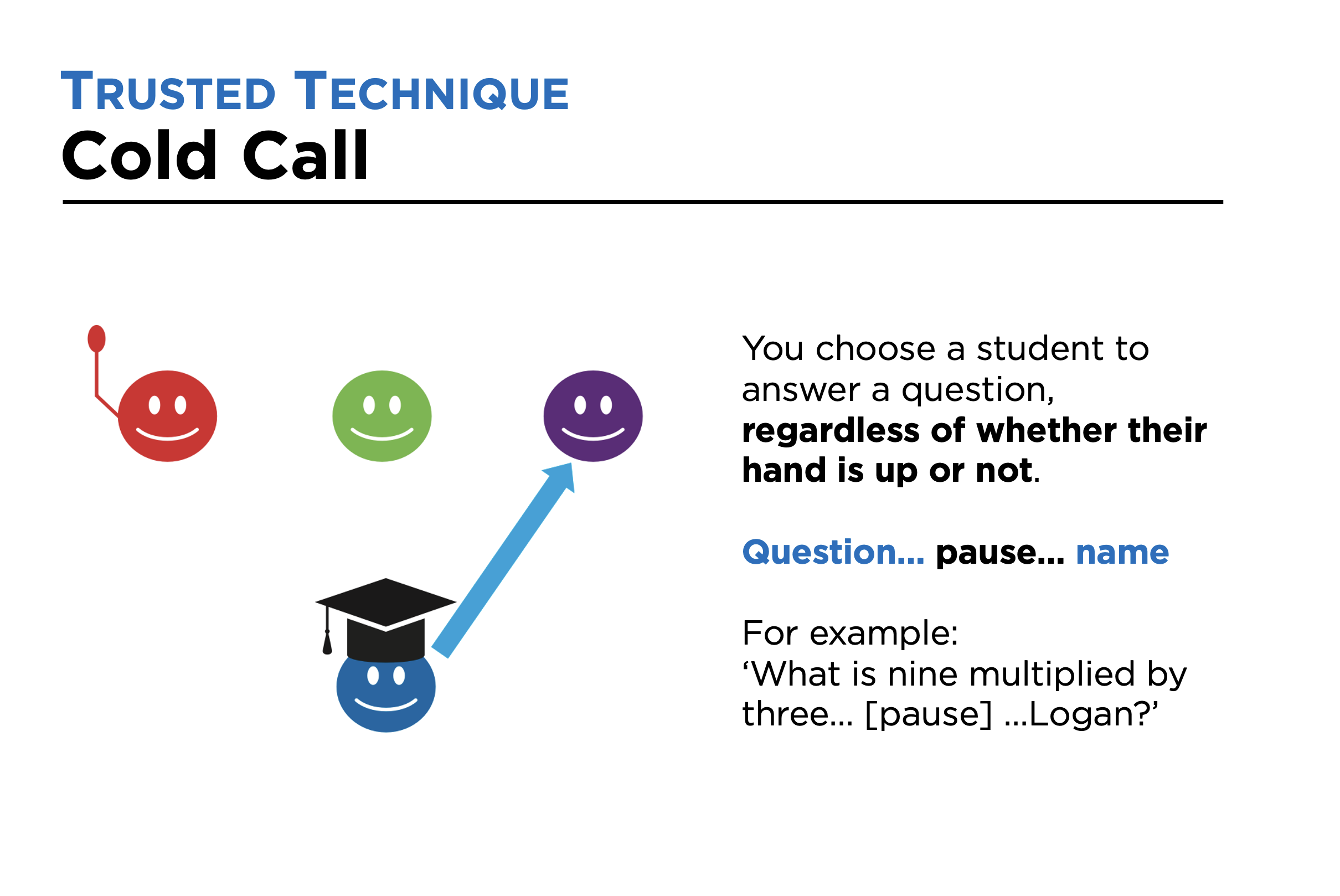
When you use the Trusted Technique Cold Call (Teaching Like A Champion, Doug Lemov), you ask a question, pause and then name a student to answer, regardless of whether their hand is up or not.
Why use this technique?
Just because you ask a question, it doesn’t mean everyone will think about it. Cold Call encourages more students to pay attention and think because anyone could be chosen to answer. It can also stop the same students from dominating question/answer exchanges and can help shy and less confident students to participate (so long as you use the technique in a ‘warm’ way).
Example
In a music lesson…
Teacher: ‘What is the name of this chord… [pause] …Charlie?’
Notes and tips
To use Cold Call most effectively, ask a question before you name a student to answer, rather than naming the student and then asking the question. If you name the student first, it’s less likely others in the class will think about the question, because they don’t believe it’s a question being directed to them.
Because students are allowed to put their hands up, this technique is different from ‘no hands up’ approaches. Allowing students to put their hand up can help you to gauge the difficulty of a question. It can also help create an ethos of enthusiasm and willingness to participate in lessons.
Cold Call offers a great means for you to control the pace of the lesson. If you want the lesson to have some urgency, you can ask a succession of Cold Call questions, each with just a few seconds’ thinking time. For example, you might say, ‘Can you name a prime number between one and 20, please… Jordie?’ Jordie says, ‘Five,’ and then you say, ‘Good. Please name another one… Erin.’ Erin says, ‘19,’ and you say, ‘Good. Let’s have another one… Poppy.’ This continues for as long as you think there is value.
If you want to slow things down, you can let students have more thinking time with each question.
Contrary to criticisms that are sometimes directed at Cold Call, used correctly (with a warm tone and supportive intentions), the technique is one of the most inclusive questioning strategies available to teachers. Students who are keen to participate but too shy to put up their hand are supported to do so when the teacher ‘cold calls’ them.
Focused reflection
How well do you currently use this technique?
Is it a technique you will focus on developing?
If so, what are the key features you will focus on (things to do, and not do)?