
Coax It Out
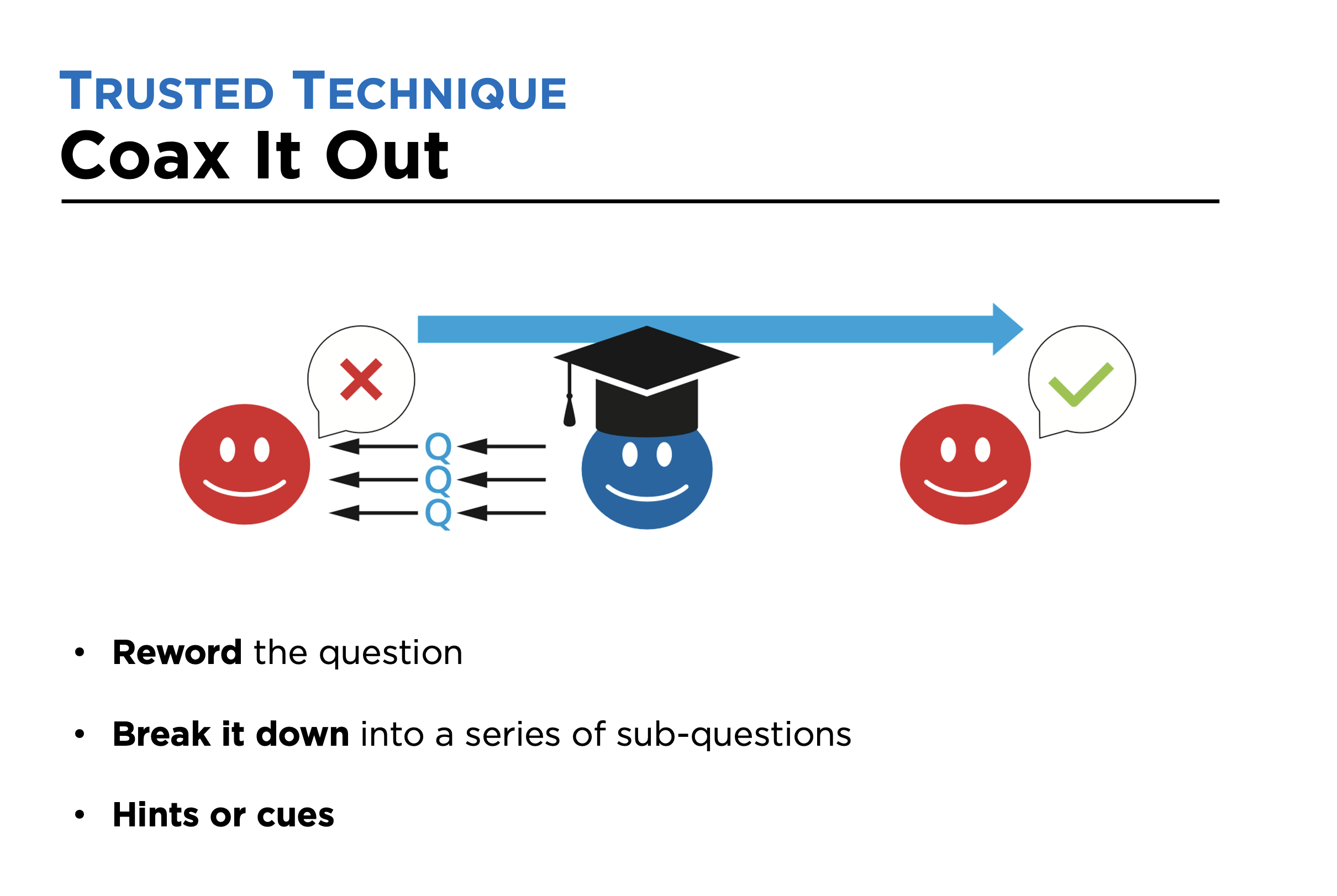
A student gets an answer wrong or says ‘I don’t know’, so you use Coax It Out to help the student get the correct answer. For example, you might:
Reword the question
Break the question down into a series of sub-questions
Use hints or cues
Why use this technique?
Often, the learning is in the struggle. That’s why we talk about ‘desirable difficulties’ as being so important. By telling a student the correct answer or by getting another student to do the same, we create a ‘thinking get-out’ for the student who couldn’t answer. It should be better for the students’ learning to support them to arrive at a good answer themselves. Coax It Out can bridge the gap between struggle and success.
Example
In a maths lesson, with a rectangle drawn on the board…
Teacher: ‘What is the area of the rectangle… Elsie?’
Elsie: ‘I don’t know.’
Teacher: ‘Okay. Well, is there anything you do know about calculating the area of a rectangle?’
Elsie: ‘No.’
Teacher: ‘Okay. Well, if I told you it has something to do with either adding or multiplying numbers, would that help?’
Elsie: ‘Um… do you multiply the sides together?’
Teacher: ‘You don’t think that you add them?’
Elsie: ‘No, I think that would give you the perimeter.’
Teacher: ‘Well done. So, keep going. What happens if you multiply the sides together?’
Elsie: ‘You get 54.’
Teacher: ‘Try again.’
Elsie: ‘You get 56.’
Teacher: ‘Perfect. And what would the units be?’
Elsie: ‘Centimetres.’
Teacher: ‘Try again.’
There is a pause for five seconds.
Elsie: ‘Centimetres squared.’
Teacher: ‘Spot on. Well done. So please tell us the correct answer.’
Elsie: ‘56 centimetres squared.’
Notes and tips
When using this technique, be mindful of using a supportive and encouraging tone of voice. There is more than one way to say ‘try again’ and not all of them come across as kind (which is, of course, how we should be trying to come across).
Focused reflection
How well do you currently use this technique?
Is it a technique you will focus on developing?
If so, what are the key features you will focus on (things to do, and not do)?