
Guard Against Guessing
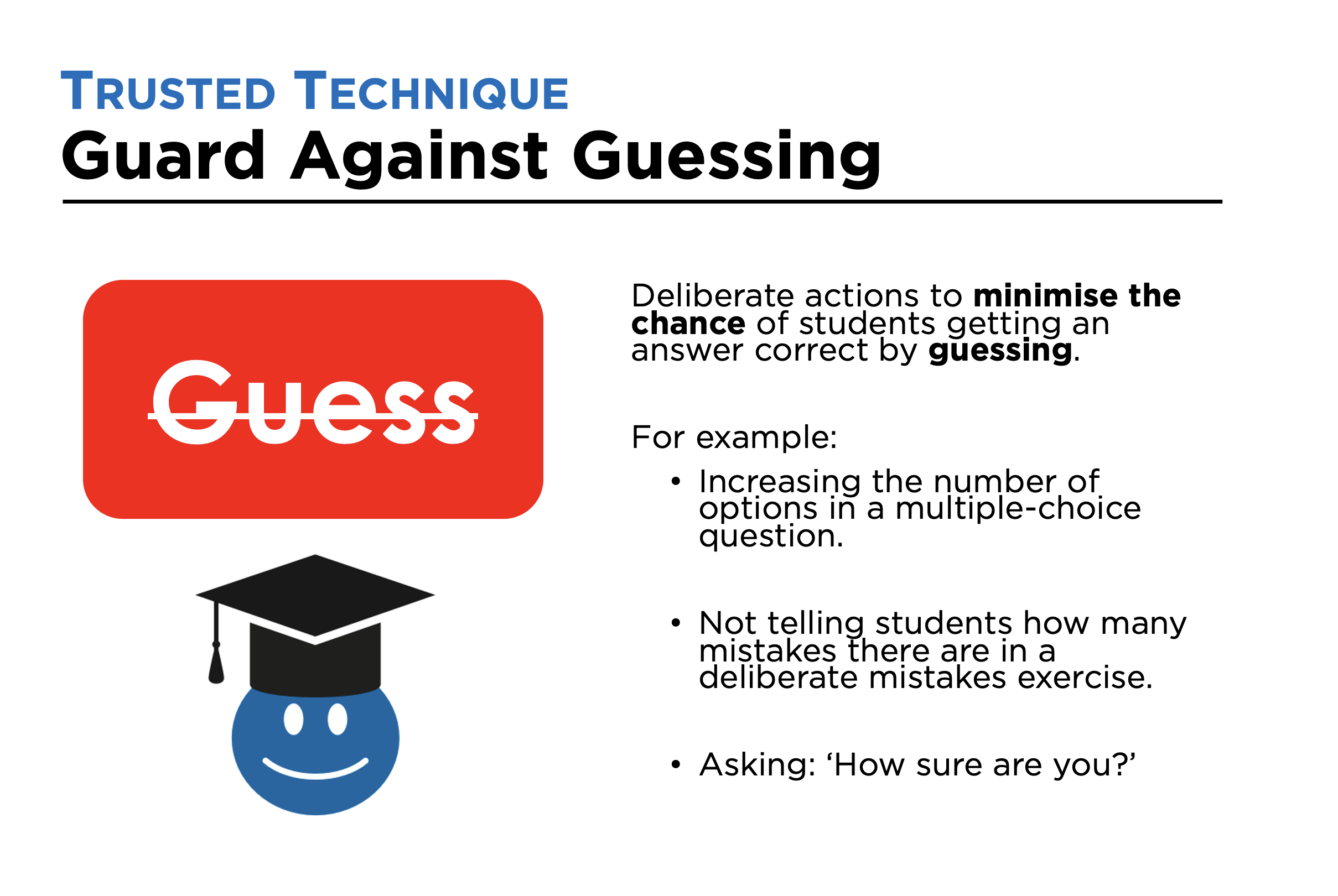
With the technique, Guard Against Guessing, you take deliberate action to minimise the chances of correct answers being the result of a guess, usually by not telling students how many correct answers there are in a problem. For example:
In English, you might show students a sentence and ask them to identify all of the nouns in the sentence, rather than the noun in the sentence.
In maths, you might show students a range of numbers, 1, 2, 3, 4, 5, 6 and 7, and say, ‘Identify all of the prime numbers’, rather than, ‘Identify the three prime numbers’.
In science, you might show students a list of animals - crocodile, shark, bat, parrot and turtle – and say, ‘Name all of the mammals in this list’ as opposed to, ‘Name the mammal in this list’.
Why use this technique?
Correct answers in themselves don’t tell us that students know something - they just tell us that a student got an answer correct. Guard Against Guessing helps minimise the chances that correct answers are the result of a guess. As well as this, the technique can help encourage harder thinking, which should be good for students’ learning.
Notes and tips
You can use Guard Against Guessing in multiple choice tasks two different ways. The first way is to increase the number of options for students to choose from (for example, A, B, C, D or E, rather than A, B or C). The second way is to tell students there could be more than one correct option, but not tell them how many there are.
Focused reflection
How well do you currently use this technique?
Is it a technique you will focus on developing?
If so, what are the key features you will focus on (things to do, and not do)?