
Go Again
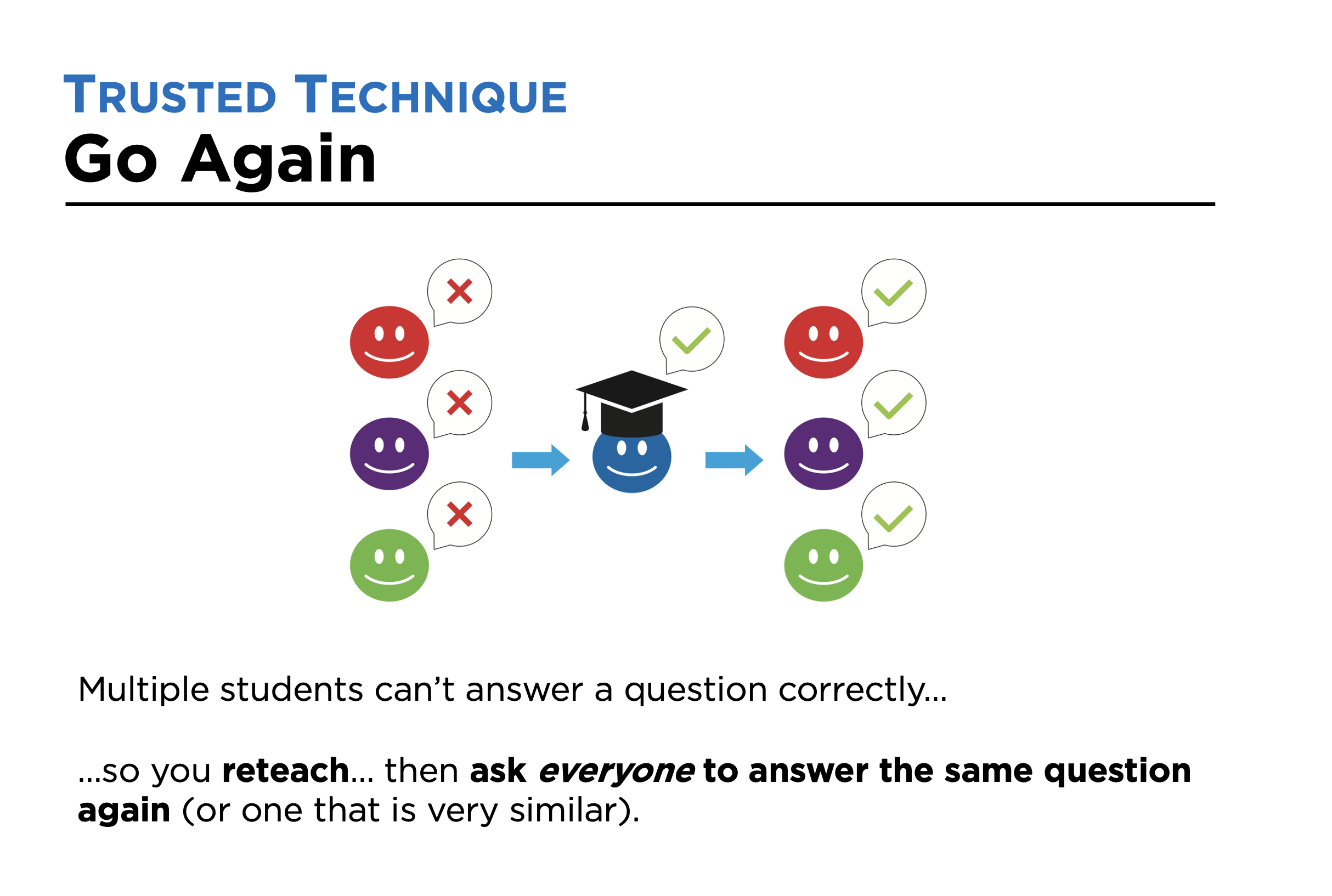
The technique Go Again is useful in the scenario where you discover a significant number of students can’t answer a question. You explain what the answer should be and then ask the same question, or one that is similar, a short time later, monitoring to check that everyone gets it correct now. (For example, you might use Show-me Boards.) If you don’t achieve a minimum level of success (at least 80%, as a rule of thumb), you repeat the process.
Why use this technique?
Not being able to answer a question is okay, so long as students can answer correctly the next time it is asked. This technique makes this expectation clear and encourages students to take ownership of their learning.
Example
In an English language lesson…
Teacher: ‘On your show-me boards, write a short sentence that includes an adjective, and underline the adjective. You have one minute and then I’ll ask everyone to hold their boards up at the same time.’
The teacher waits as students write answers. After 60 seconds, they ask everyone to hold up their boards. Out of a class of 25 students, only four have answered correctly.
Teacher: ‘Okay, I can see that most of you struggled with that. Julie, Jason, Claire and Phillipa – well done. You all did this well. Phillipa, could you remind the class what an adjective is, please?’
Phillipa: ‘It’s a word that tells us more about a noun.’
Teacher: ‘Thank you. Everyone, let’s look at what Phillipa has written on her board.’
The teacher holds up the board for everyone to see, which looks as follows:
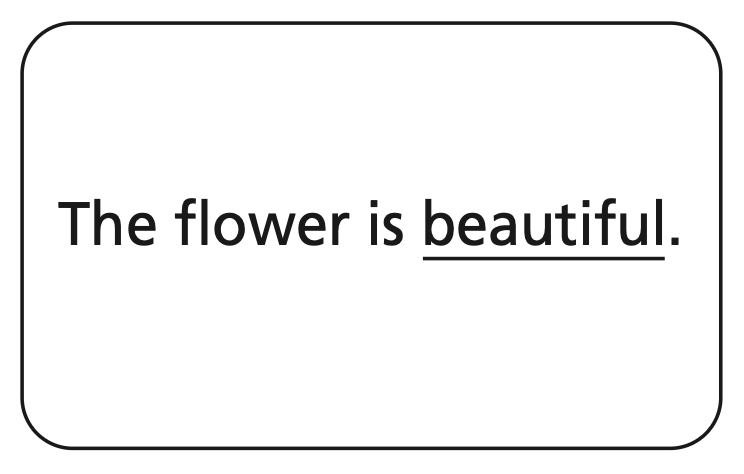
Teacher: ‘Phillipa has written “The flower is beautiful” and has underlined the word beautiful. “Beautiful” is telling us more about the noun in the sentence. What is the noun, please… Suzanne?’
Suzanne: ‘Flower.’
Teacher: ‘That’s right. So, the adjective – beautiful – is telling us more about the noun – flower. I would like everyone to rub out what they just wrote on their boards and give me a new example of a short sentence with an adjective, underlining the adjective.
The class does this, and the teacher sees 18 correct answers.
Teacher: ‘That’s much better, I can see almost all of you have got that right this time. However, there are still a few of you who haven’t. Christine, I want you to talk us through your answer and then everyone is going to have another go.’
Christine does this and the teacher makes further teaching points. Everyone has another go and 23 out of 25 students get the answer correct.
Teacher: ‘Very well done everyone. That’s a big improvement. There were just a couple of you who are still struggling. That’s fine. I’m going to come and work with you both later in the lesson.’
Notes and tips
When you are asking the class to Go Again, the worry can often be that you are wasting the time of the students who have already proven they can answer a question. However, that’s not usually true, especially when they are generating different examples. Usually, there is real benefit to students going again because it results in overlearning. Essentially, the memory being created becomes even stronger than it would otherwise have been, meaning it is even less likely to be forgotten in the future. Beyond this, students usually get a lot of satisfaction out of getting things right. Giving them multiple opportunities to do this isn’t usually something they will complain about, so long as they feel their learning is developing as the lesson goes on.
Focused reflection
How well do you currently use this technique?
Is it a technique you will focus on developing?
If so, what are the key features you will focus on (things to do, and not do)?