
Full Attention
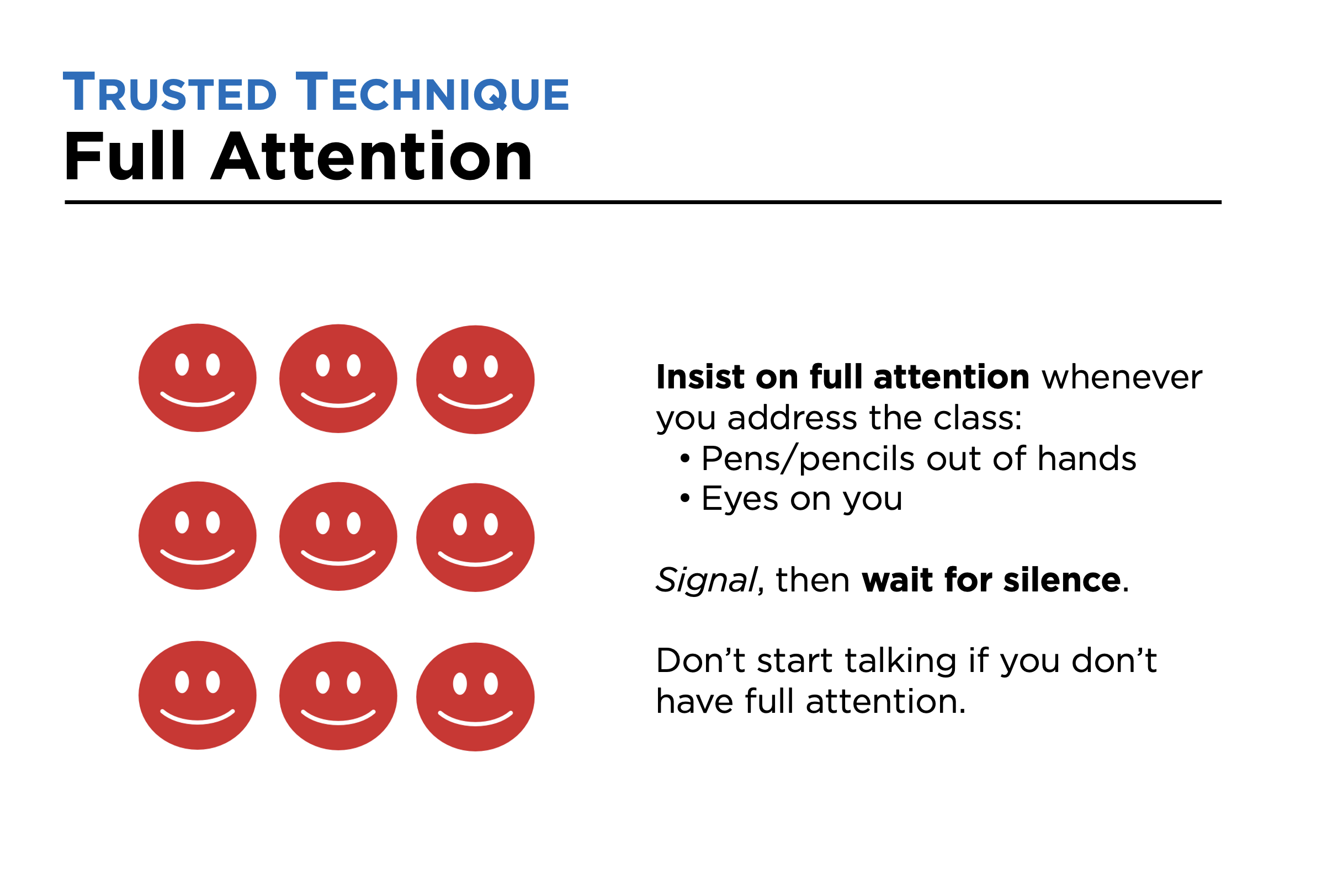
With the technique, Full Attention, whenever you address a class, you insist on students having eyes and ears on you, with nothing in their hands. You do this in a two-step process:
Signal
Wait
The signal could be verbal (for example, ‘Okay class…’) or non-verbal (for example, putting up your hand).
The wait relies on you being both patient and confident that you will get full attention. Don’t fall into the trap of starting to speak to the class until you have full attention. If necessary, give a second signal and wait a bit longer, or, if necessary, take the time to re-teach the routine.
Why use this technique?
The first part of any learning sequence involves students paying attention to the things you want them to think about. In part, this technique is about ensuring everyone is paying attention to what you are saying and doing. It also helps ensure no student is distracting another.
Another reason for using Full Attention is to emphasise the fact that there are rules that everyone is expected to follow. If you start to speak when you don’t have the full attention of everyone, inadvertently, you are signalling that it is okay for some students to break the rules. This makes it more likely other students will do the same.
Notes and tips
Like most techniques relating to student behaviour, students need taught how to behave in particular situations (in this case, when you give a signal for full attention). This will take time, practice and feedback. Your aim is to create a routine so students know exactly what to do when you give a signal, and do this quickly.
Focused reflection
How well do you currently use this technique?
Is it a technique you will focus on developing?
If so, what are the key features you will focus on (things to do, and not do)?