
Instruct Memorisation
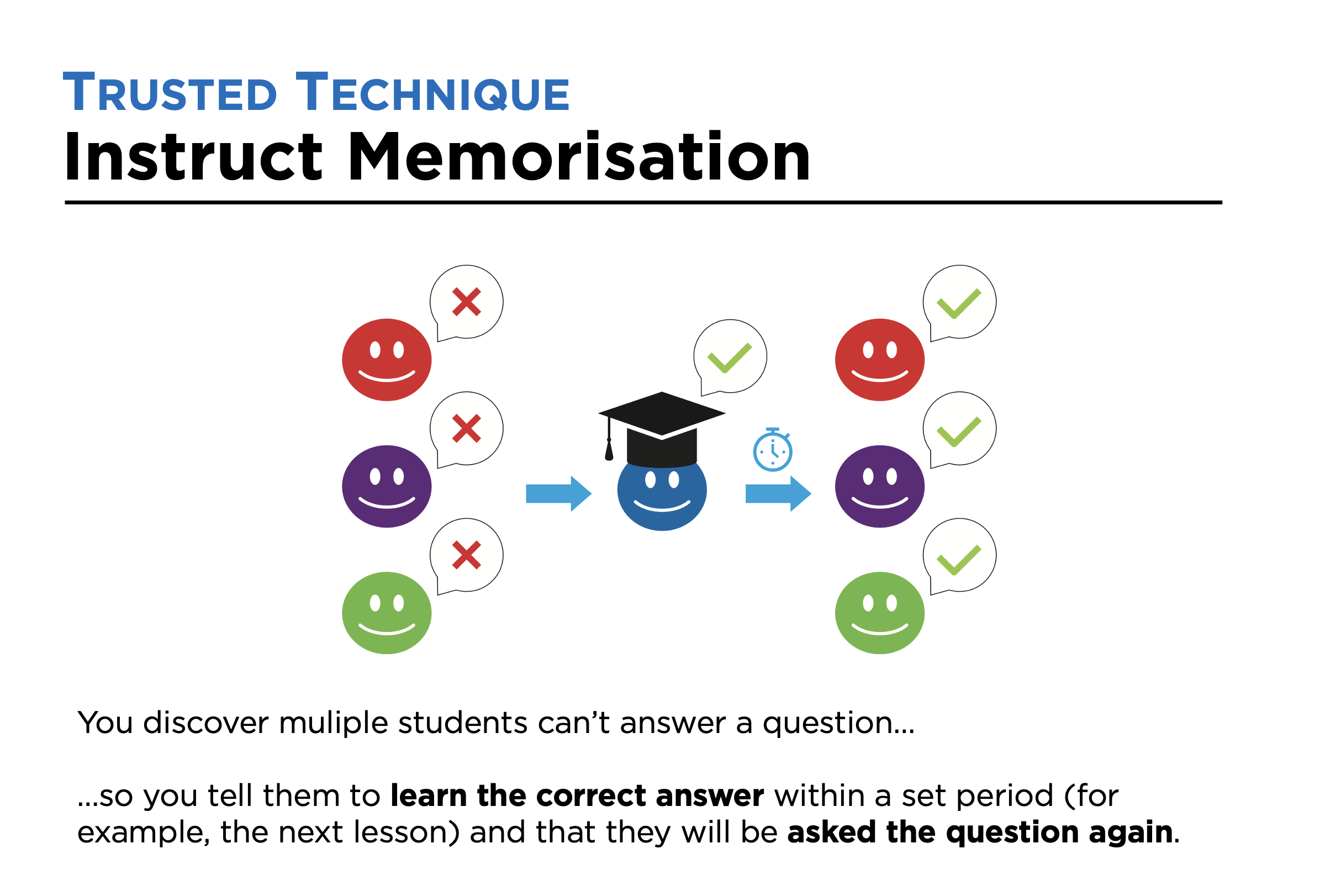
You discover that a significant number of students can’t answer a question that they are expected to be able to answer. You tell students that they need to learn the correct answer within a set period - you Instruct Memorisation - and that they will be asked the question again. For example, you might say:
‘I want you to spend 5 minutes taking steps to memorise this.’
‘I need you to make sure you have memorised this by the next lesson.’
Why use this technique?
Not being able to answer a question is okay, so long as students can answer it the next time it is asked. This technique makes this expectation clear and encourages students to take ownership of their learning.
Example
In a music lesson…
Teacher: ‘Last lesson we were learning about different genres of music from the 1980s. Who would like to remind us what these were?’
The teacher pauses. Tumbleweed.
Teacher: ‘Would you be able to tell us what one of these was please… Audrey?’
Audrey: ‘I don’t know.’
Teacher: ‘Okay. Well, if I said one of them began with an S, would that help?’
Audrey: ‘No.’
Teacher: ‘Okay. James, would you be able to help out?’
James: ‘No.’
Teacher: ‘Right. Well, if anyone thinks they know even just one, put up your hand.’
No hands go up.
Teacher: ‘Okay, well that’s a shame. This was something we discussed in our last lesson. There were three different genres: synth pop, hip-hop and house music. Try to remember that two of them rhyme with one another and two of them start with the same letter. You have these written in your knowledge organisers. I would like you to do some active study so that you know these when I ask everyone to write these on show-me boards tomorrow.’
Notes and tips
For this to be successful, you need to make sure students have access to resources that will allow them to learn the correct answer. This might be a textbook, their notes jotter or a knowledge organiser.
It would also be helpful to make sure students have been taught how to use active study strategies to help learn information, such as read-cover-write-check-correct or flash cards (as opposed to students rereading material, highlighting it or copying it out, which are less effective learning strategies).
Focused reflection
How well do you currently use this technique?
Is it a technique you will focus on developing?
If so, what are the key features you will focus on (things to do, and not do)?