
Interleaving
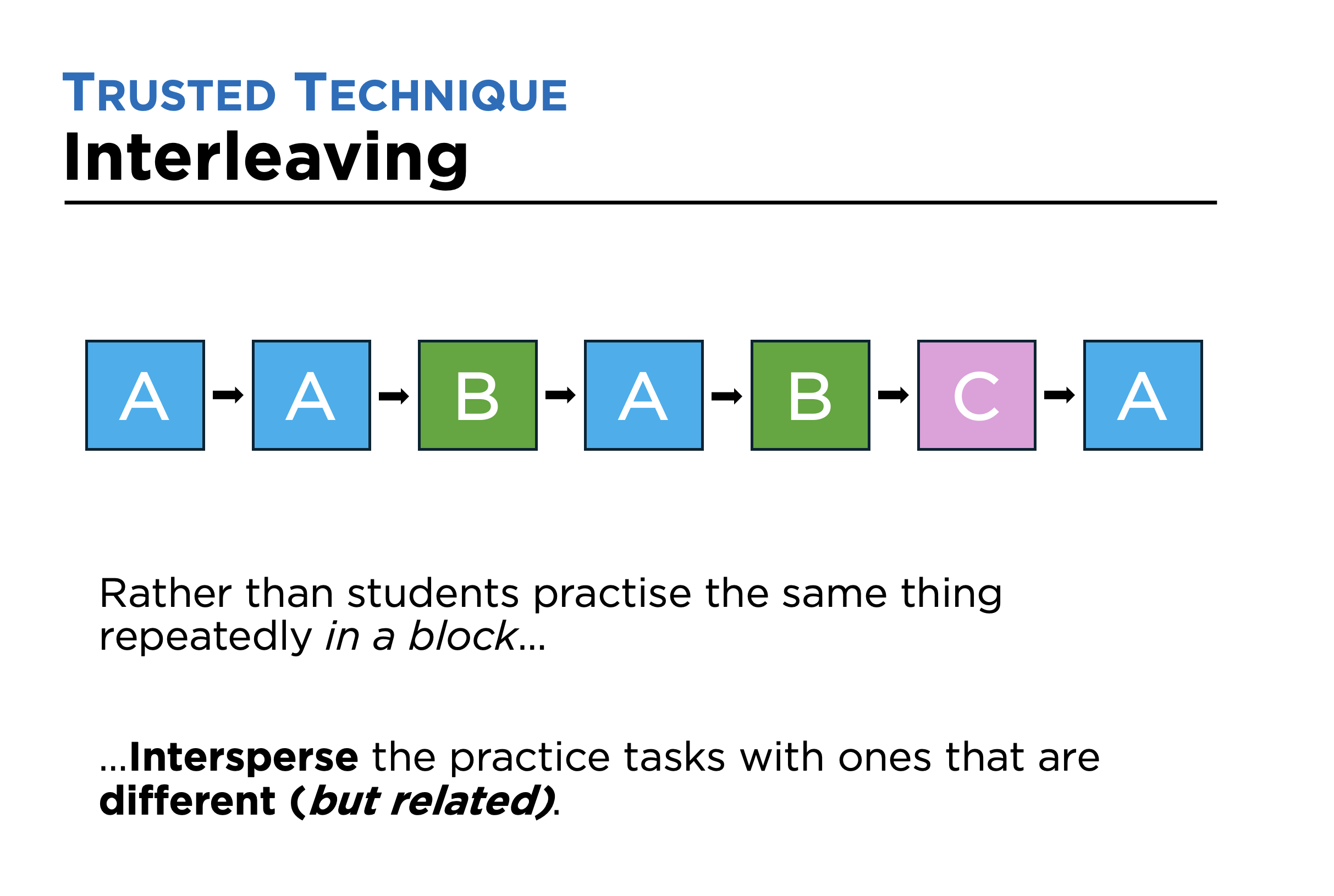
With the technique, Interleaving, you mix up the skills students are practising in a given practice session, rather than have students practise the same skill repeatedly in a block (which is called ‘blocking’). Students practice a specific skill [A], then a different one [B], then might go back to [A] before moving on to [C], then back to [B], etc.
Why use this technique?
Interleaving can have two positive benefits on students’ learning:
When students move from skill A to skill B, they stop thinking about skill A and start thinking about skill B. When they go back to skill A, they have to start their ‘skill A thinking’ process again. The cognitive effort associated with switching between different thinking processes should be good for strengthening their memory of how to perform each skill.
If there are similarities between the different skills students are practising, the process of moving from one to another can support students’ metacognition. Moving from skill B from skill A, students are encouraged to ask themselves questions such as: ‘In what ways is this the same and different to what I was just practising?’ and ‘What do I need to differently in this task compared with the last one?’. This act of comparing and contrasting should be good for the development of knowledge connections in schema.
Examples
In maths, you might ask students to practice problems that involve calculating the perimeter of squares, the area of squares, the perimeter of rectangles and the area of rectangles. Rather than discrete blocks, the tasks are mixed up.
In English, you might mix up the tasks that require students to identify the nouns, verbs and adjectives in sentences.
Notes and tips
Interleaving and blocking can both benefit learning, but one is more likely to have a more positive impact than the other, depending on where students are in a learning sequence. Generally:
Blocking should be best in the earlier stages of learning something new, to help develop confidence and a degree of knowledge security.
Interleaving should be best later in a learning sequence, once confidence and a degree of knowledge security have been developed.
As a rule of thumb, start with blocking and once you have observed sufficient success, introduce interleaving. If students are struggling with this, it probably makes sense to go back to blocking.
To be most beneficial to learning, Interleaving should focus on related problems, rather than ones with big differences. For example, if you are teaching students how to multiply fractions in maths:
If you mix up problems that involve common denominators with those that involve uncommon denominators, this requires students to compare and contrast related problems.
If you mix up multiplying fractions problems with calculating percentages problems, the significant differences between these two types of problem are too big to reap any compare and contrast benefits.
Focused reflection
How well do you currently use this technique?
Is it a technique you will focus on developing?
If so, what are the key features you will focus on (things to do, and not do)?