
Pause
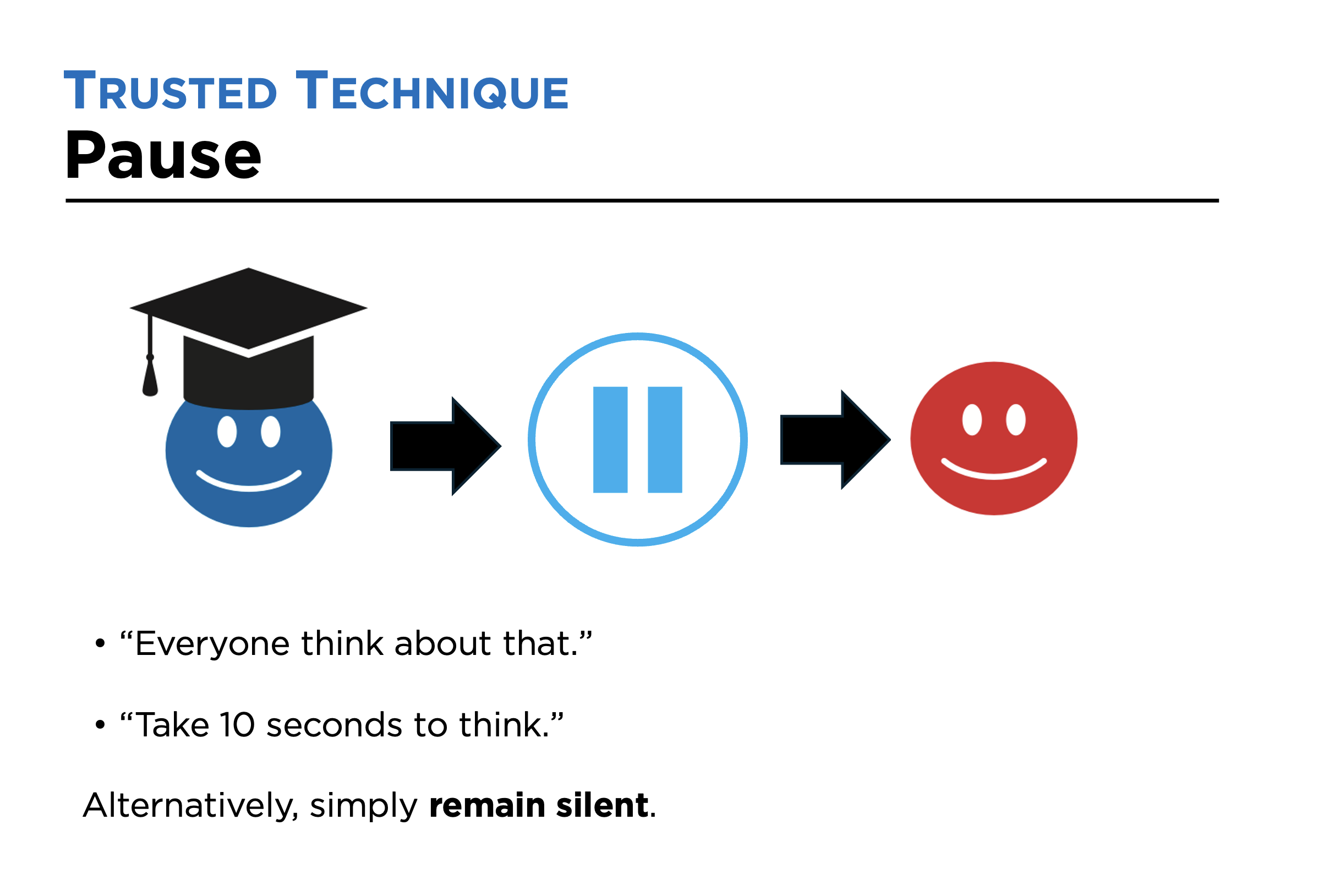
With the questioning technique Pause, you get into the habit of leaving a short period of silence after asking a question. You might do this by using a phrase along the following lines when you ask a question:
“Everyone think about that for a moment.”
“Take 10 seconds to think about that.”
“Think about that – everyone.”
Alternatively, you simply remain silent and use your body language to convey your expectation that everyone should be thinking.
Why use this technique?
Pause makes it more likely that more students will be thinking about the question you asked than if you choose a student to answer immediately. It should also address ‘rabbit in the headlight’ moments whereby a student panics and tells you ‘I don’t know’ (even though they do) because they didn’t have enough time to think.
Example
In a French language lesson…
Teacher: ‘How do we ask where the nearest train station is? Ten seconds to think about that, everyone.’
Ten seconds pass, which the teacher counts in their head.
Teacher: ‘Okay, tell us what you think, please… Stephanie.’
Notes and tips
The amount of thinking time you allow will depend on the difficulty or complexity of the question you ask. Sometimes, all that will be needed is a few seconds. Other times, it might be a minute or more. Use your judgement.
Try not to fall into the trap of saying anything during thinking time. Instead, embrace the silence. Students can’t think and listen to what you’re saying. Similarly, don’t give in to any temptation to choose ‘keen students’ to answer before the thinking time is over, even if they put their hand up or gesture vociferously for your attention.
If you have established a ‘thinking-time culture’, you might not need to say things like ‘everyone think about that’. Instead, everyone just knows this is the expectation. That said, it probably doesn’t hurt to give reminders from time to time.
Focused reflection
How well do you currently use this technique?
Is it a technique you will focus on developing?
If so, what are the key features you will focus on (things to do, and not do)?