
Phone a Friend
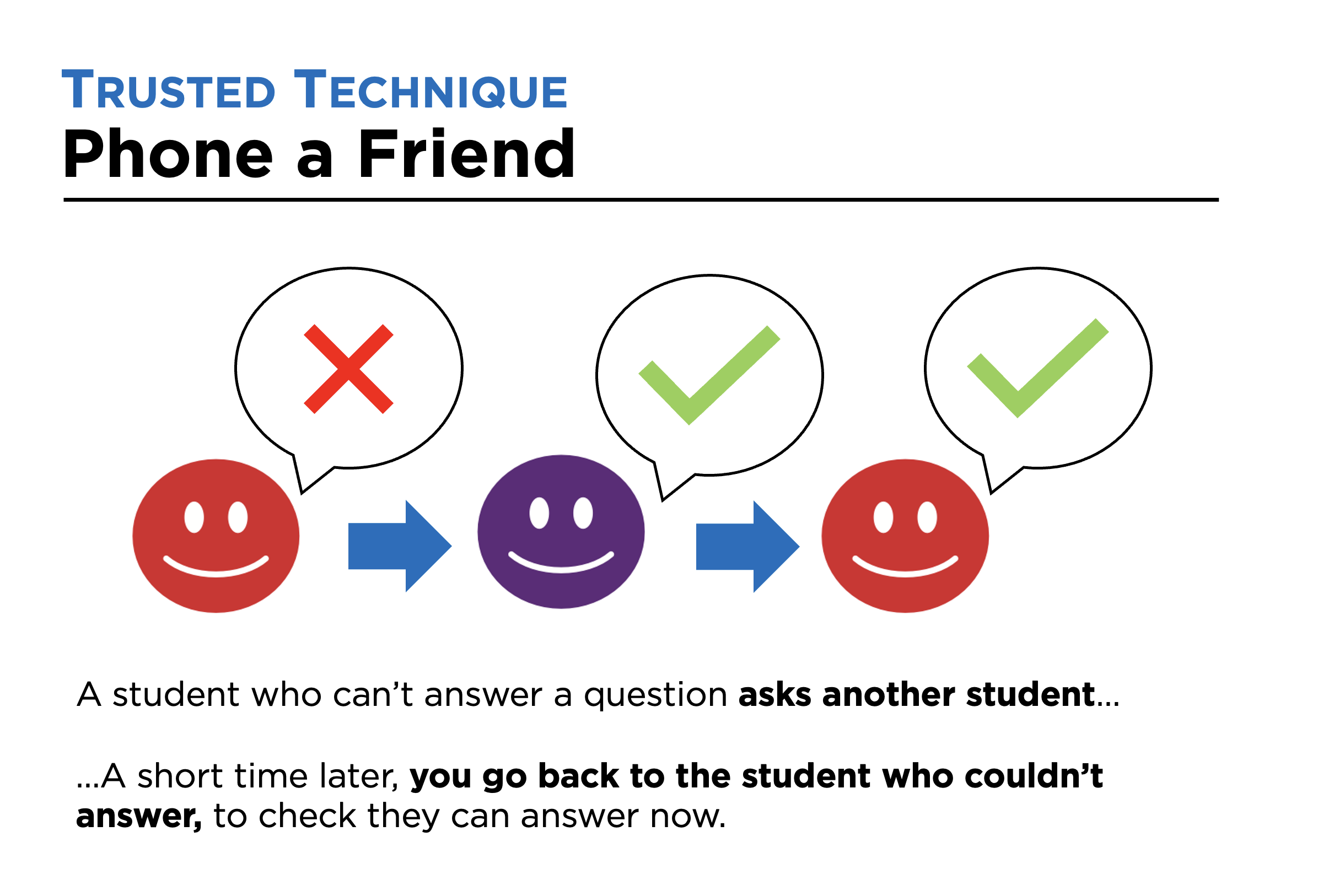
A student gets an answer wrong or says ‘I don’t know’, so you allow them to choose another student to answer. A short time later, you go back to the student who didn’t know to check they do now. They Phone a Friend. Importantly, a short time later, you go back to the student who didn’t know to check they do now. This could be done in one of three ways:
Asking them the same question - or a very similar one - again as part of whole-class teaching (but taking care not to embarrass them).
Asking everyone to answer the question on Show-me Boards, but paying particular attention to the student who didn’t know the answer or got it wrong previously. For example, you might say: ‘The last time I asked this question, not everyone got it right. So, I’d like to check that everyone knows now’.
Asking them privately during supported or independent practice.
Why use this technique?
Phone a Friend keeps the requirement to answer questions correctly with students. This helps ensure there is a ‘desirable difficulty’ and reinforces the teacher’s expectations that students listen to each other’s answers, so that learning is collaborative.
Example
In a maths lesson…
Teacher: ‘What is −4 × 3… Max?’
Max: ‘I don’t know.’
Teacher: ‘Are you sure? I remember you answering a question like this in our last lesson.’
Max: ‘Sorry, I’m not sure.’
Teacher: ‘Okay. Well, phone a friend.’
Max: ‘I’ll phone Erin.’
Teacher: ‘Okay, Erin. Can you help?’
Erin: ‘Yes. It’s −12.’
Teacher: ‘Thanks, Erin. Can you explain how you arrived at that answer, please?’
Erin explains her thinking.
Teacher: ‘That’s very good. Right, Max, back to you. I’m going to ask you a very similar question and, based on what Erin has just explained, I’m hoping you’ll be able to answer it. What is −2 × 4? I’d like everyone to take a minute to work that out, but Max, I’m going to come to you first.’
Notes and tips
As shown in the example, the technique can get the whole class to think, even if only a few students are chosen to answer.
Don’t let the same student (or group of students) always get chosen as the ‘friend’. If you need to, intervene and insist that someone else is chosen.
Focused reflection
How well do you currently use this technique?
Is it a technique you will focus on developing?
If so, what are the key features you will focus on (things to do, and not do)?