
Positive Framing
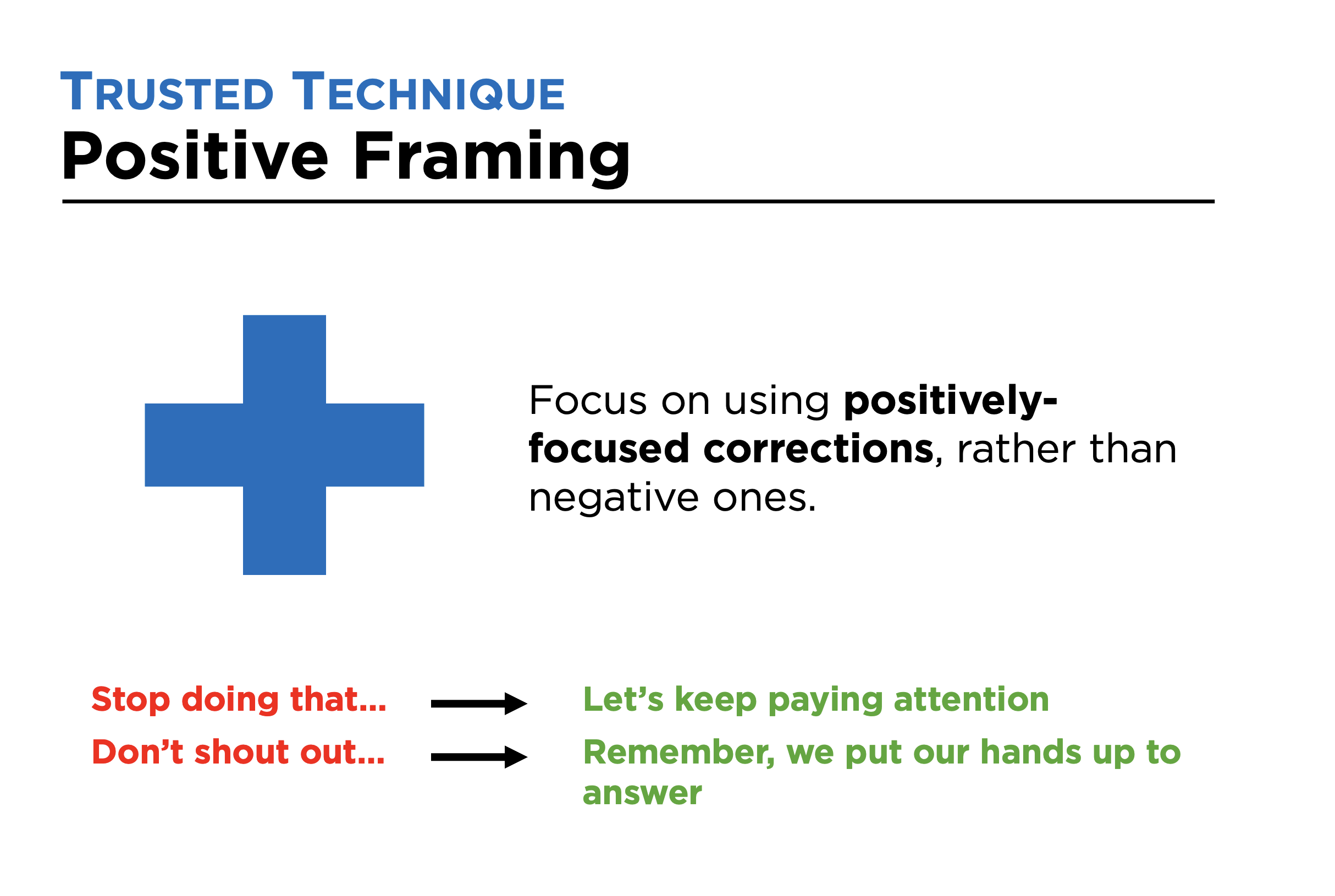
With the technique, Positive Framing, you focus on putting a positive spin on verbal corrections, highlighting the behaviour you are looking for (rather than the one you want to stop).
For example:
‘Let’s keep paying attention’ (rather than ‘Stop doing that’).
‘Remember, we put our hands up to answer questions’ (rather than ‘Don’t shout out’).
Why use this technique?
The more positive the language we use, the more likely students will accept what we are saying without an accompanying negative reaction.
The same is true of making clear the behaviours we want to see. For example, if a student is running down a corridor and you say, ‘Stop running’, a student might retort, ‘I wasn’t running!’ (even though they were), which might lead you to retort, ‘Yes you were!’ (you can imagine how this plays out). If, instead, you used Positive Framing and said, ‘Just walk’, you are much less likely to get a negative retort and more likely to get the behaviour you are looking for. (It’s a bit like if you say, ‘Don’t think of a polar bear’, and of course, people do. Saying, ‘Just walk’ is more likely to lead to your desired outcome than ‘Don’t run’.)
Focused reflection
How well do you currently use this technique?
Is it a technique you will focus on developing?
If so, what are the key features you will focus on (things to do, and not do)?