
Tell A Story
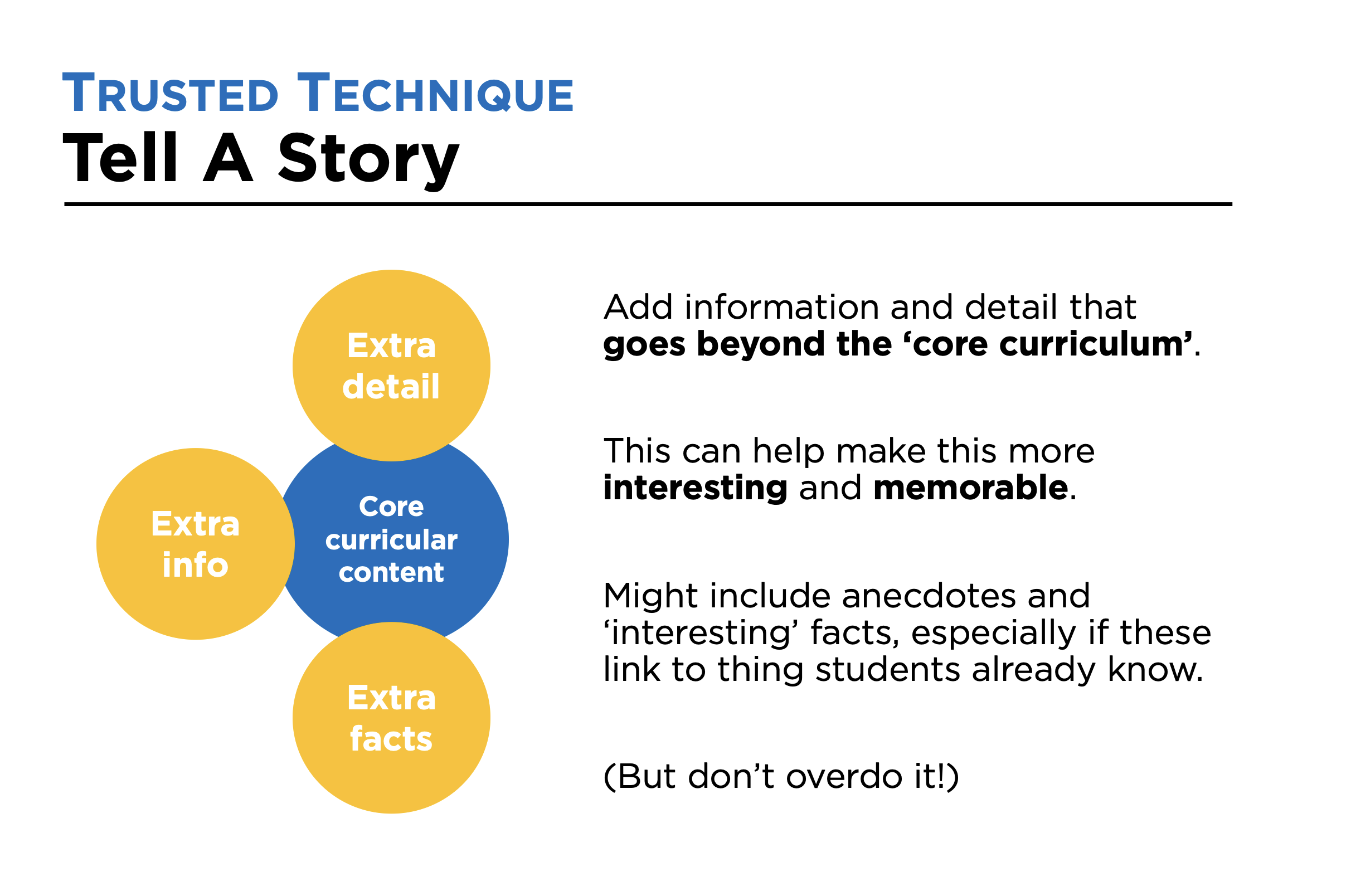
With the technique, Tell a Story, you use facts and anecdotes to complement your explanations of core curriculum content.
Why use this technique?
Told well, stories can be a great way to make content interesting. So long as they link closely to the content being taught and you make a point of emphasising and reinforcing key learning points, stories can also help make content memorable. They contain hooks that can be helpful for developing schemata.
Example
For example, if you want students to learn the order of planets in our Solar System, you could present a labelled diagram, ask students to take one minute to memorise the order, and then ask them to reproduce this from memory. This would probably be effective at achieving the learning goal, but it is a little dry.
To make it more interesting, you could also tell a story. For example, as you talk through the labelled diagram, you could tell students:
Venus is the second planet from the Sun and the third brightest object in Earth’s sky after the Sun and Moon. It is sometimes referred to as the sister planet to Earth, because their size and mass are so similar. Venus is also the closest planet to Earth. The surface of Venus is hidden by an opaque layer of clouds that are formed from sulphuric acid. The planet is named after Venus, the Roman goddess of love and beauty, and is the second largest terrestrial planet.
Much of the information in the story goes beyond what you probably want students to learn. In that sense, it is extraneous information. However, all of it has the potential to make the core content more interesting and bring it to life. Stories help us develop a sense of history in subjects, including the key people and events that have shaped them. As the teacher, you need to make a judgement about what the ‘right amount’ of extraneous information is.
Notes and tips
To help create a good story, you might have to spend time researching interesting facts as part of your lesson preparation. You might also want to practice telling the story ahead of the lesson, perhaps to a colleague, to refine the detail and make sure your telling is as good as possible.
Focused reflection
How well do you currently use this technique?
Is it a technique you will focus on developing?
If so, what are the key features you will focus on (things to do, and not do)?