
Homing In
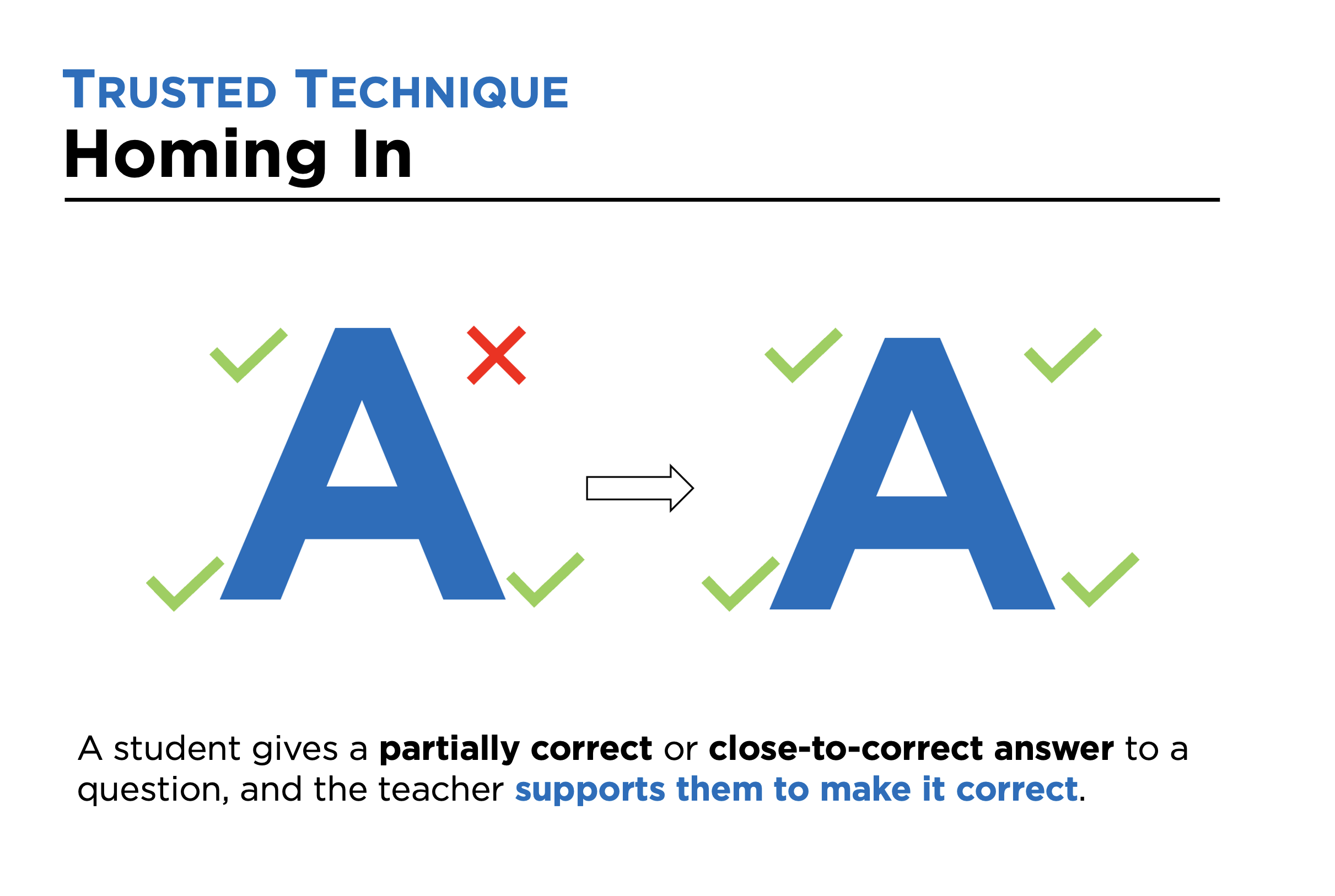
With the technique, Homing In, a student gives a partially correct or close-to-correct answer to a question and the teacher supports them to make it correct. For example:
‘That’s pretty good, Audrey, but there’s one word in your answer that wan’t quite right. Can you think what it was?’
‘I liked the first part of what you said but there was something that wasn’t quite right in the second part. What do you think that might have been?’
Why use this technique?
Students often know and understand more than their initial answers suggest. Homing In gives them the chance to ‘redraft’ and improve their answers. Encouraging them to come up with their own improvements should be more beneficial to their learning than you doing this for them. The technique requires the student to do the cognitive work, meaning their learning is more active.
Example
In a maths lesson, the following expression is presented to students:
a × a = 2a
Teacher: ‘Is this true or false? On show-me boards please, everyone.’
Everyone writes an answer, some of which say ‘T’ and some say ‘F’.
Teacher: ‘Jamie, you’ve said false. Can you tell us why you think that, please?’
Jamie: ‘Because it should be “a” times “a” equals “a” with a subscripted two.’
Teacher: ‘Nearly. Are you sure you mean subscripted?’
Jamie: ‘No, sorry. I mean superscripted.’
Teacher: ‘That’s better. Superscripted means the number appears in the top-right, which is correct.’
Focused reflection
How well do you currently use this technique?
Is it a technique you will focus on developing?
If so, what are the key features you will focus on (things to do, and not do)?