
Mnemonics
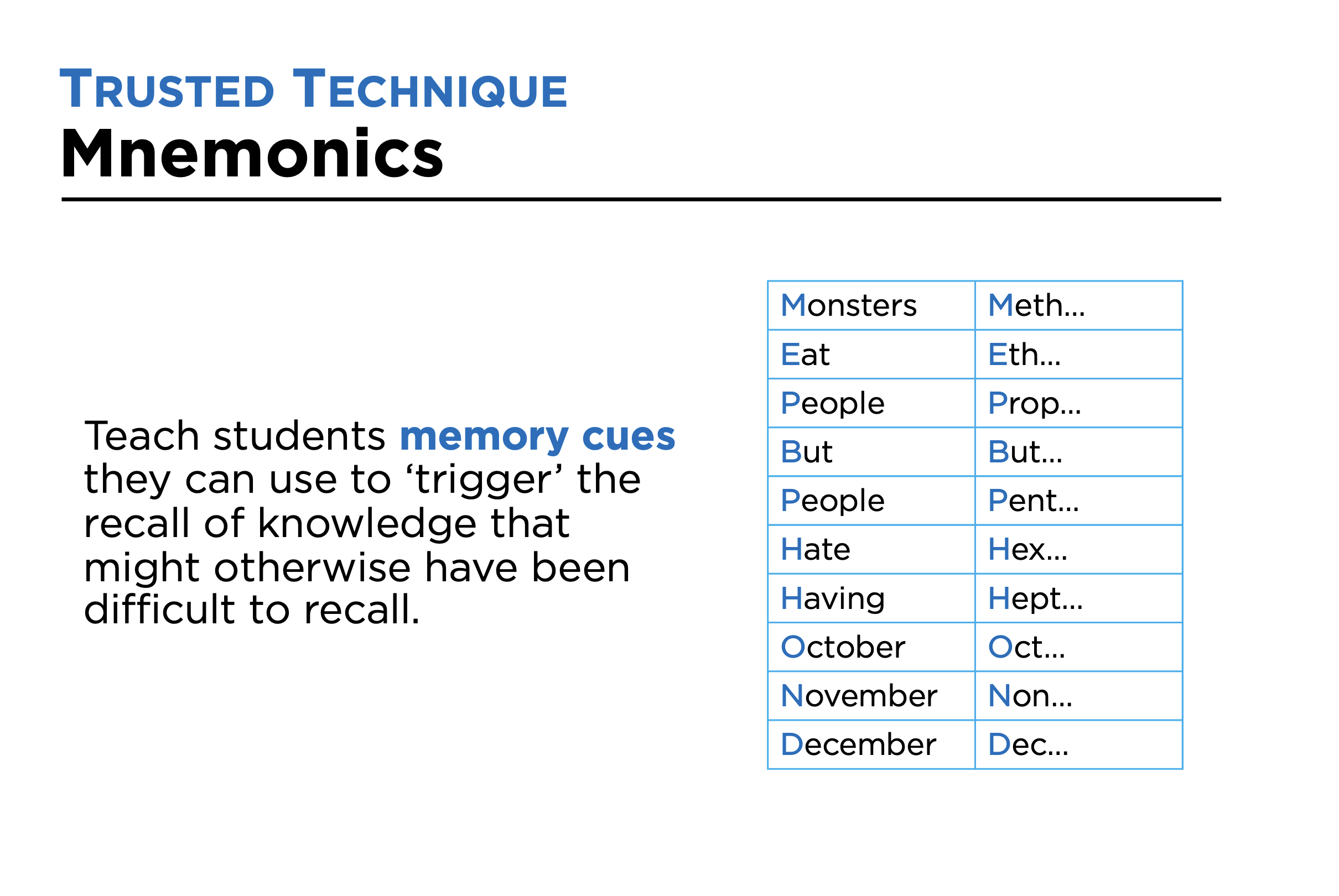
With the technique, Mnemonics, you teach memory cues that students can use to trigger knowledge recall. These are created by linking something that needs to be learned with something that has already been learned, such as words or visuals.
Why use this technique?
Mnemonics can help students remember abstract content that, on its own, isn’t especially memorable, but nonetheless needs to be learned to understand something bigger. They are particularly useful to help students learn the component parts of something, or the order of anything in a sequence.
Example
For example, in chemistry, the prefixes meth-, eth-, prop-, but-, pent-, hex-, hept-, oct-, non- and dec- need to be learned to understand the chemistry of things like alcohol, vinegar and petrol. The prefixes are quite abstract and don’t mean much in themselves. Unless they are being used a lot, they are quite forgettable. However, they can be made less forgettable if associations are made to words that students already know. For example:
Monsters (meth-)
Eat (eth-)
People (prop-)
But (but-)
People (pent-)
Hate (hex-)
Having (hept-)
October (oct-)
November (non-)
December (dec-)
Notes and tips
‘Monsters eat people but people hate having October November December’ doesn’t make any sense as a sentence, but it does help us to remember the prefixes and their order. Often, the more ridiculous the mnemonic, the better.
Mnemonics are likely to benefit learning best when students create these themselves. The harder thinking associated with this is likely to produce stronger knowledge connections than if you have done all of the work for them.
Focused reflection
How well do you currently use this technique?
Is it a technique you will focus on developing?
If so, what are the key features you will focus on (things to do, and not do)?