
Spotlight Assessment Activities
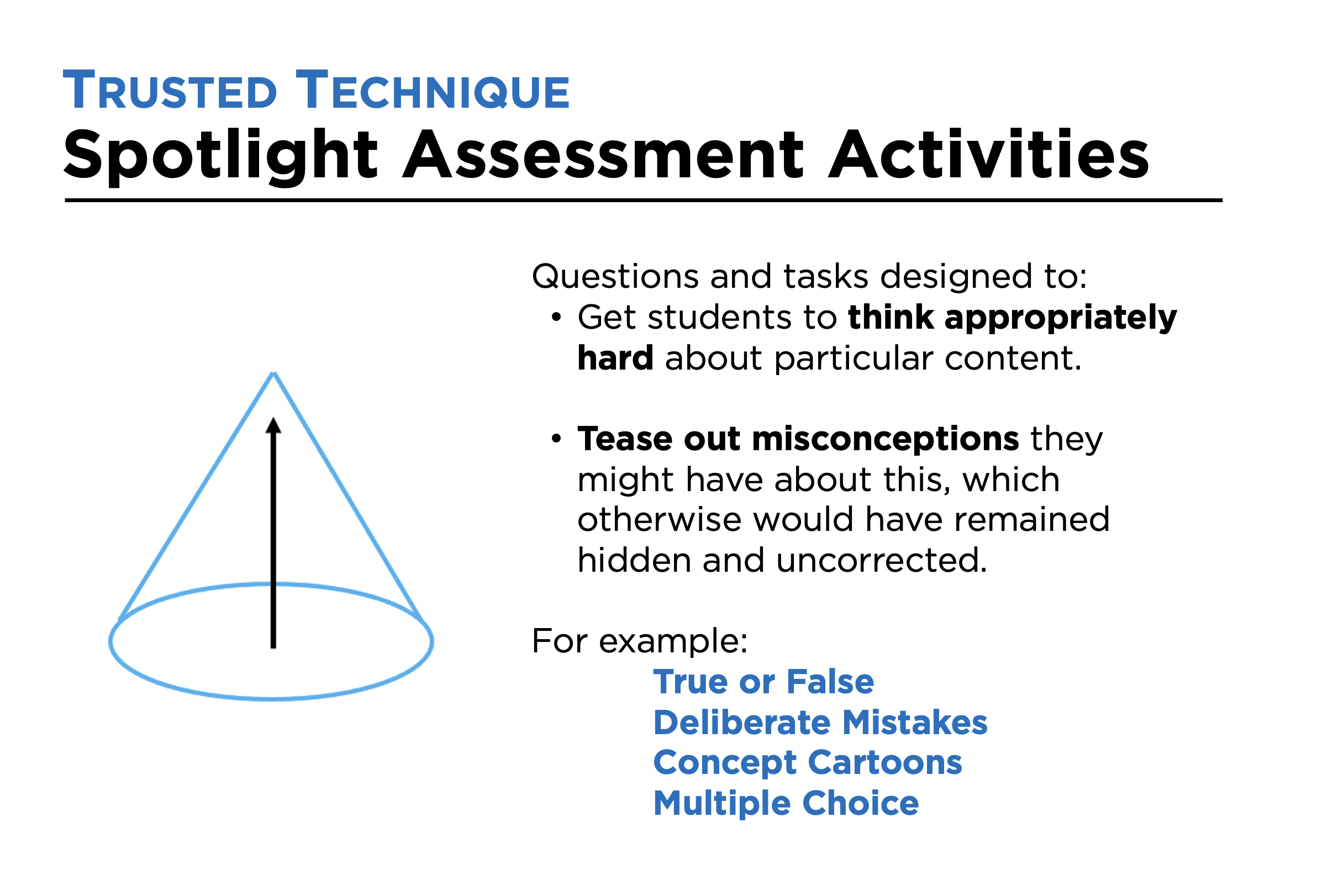
Spotlight Assessment Activities are questions and tasks that encourage students to think hard about specific things in a carefully curated way. Usually they focus on bringing common misconceptions to the surface.
Why use this technque?
Spotlight Assessment Activities encourage students to think about things in ways that more straightforward recall questions might not. As a result, they can help students develop knowledge connections, leading to deeper understanding and strengthened memory. By ‘shining a spotlight’ on specific things that students know and understand (or don’t), they produce powerful formative information to which you can respond. Beyond this, they bring variety to the sorts of questions you are asking, which can make lessons more interesting.
Examples
True or False
Deliberate Mistakes
Odd One Out
Concept Cartoons
Multiple Choice
Compare and Contrast
Tell Me Why
Empty Your Brain
Each of the above examples of Spotlight Assessment Activity is discussed as an individual technique in the Spotlight Assessment section of this website.
Notes and tips
Creating Spotlight Assessment Activities
A useful approach to creating Spotlight Assessment Activities can be:
Choose a section of content you want students to think about and that you want to check understanding of.
Individually or with a colleague, brainstorm common mistakes and misconceptions relating to this. These might have come from real answers you have been given when teaching something previously.
With the principle of desirable thinking in mind, design a Spotlight Assessment Activity that encourages students to think about this content (for example, True or False, Deliberate Mistakes or Multiple Choice).
For example, a common misconception in science is that the sun goes around the Earth. To target this, you could create one or more of the following Spotlight Assessment Activities:
True or false: the sun takes 24 hours to move around the Earth.
Find the deliberate mistake: the sun takes 24 hours to move around the Earth.
Tell Me Why the following statement is wrong: the sun takes 24 hours to move around the Earth.
Spotlight Assessment Activities can add value to all stages of a lesson – beginning, middle and end. For example, they can be used at the start to explore students’ prior knowledge; they can be used during the course of a lesson to check understanding or to get students to think about particular things in different ways; or they can be used towards the end of a lesson to check knowledge and understanding (short-term learning).
Desirable thinking
As with all questions, we are trying to promote desirable thinking. Questions that are too easy (or difficult) won’t achieve that. For example, if you are teaching an English literature lesson about Macbeth to a class of 15-year-olds and you ask, ‘True or False: Macbeth was Scottish,’ you have got students to think, but not in a desirably difficult way. A better question might be: ‘True or False: Banquo discovers Duncan’s body.’
In Spotlight Assessment Activities that offer a choice of answers (such as Deliberate Mistakes and Multiple Choice), not telling students how many correct answers there are should get them to think harder, making the question more desirably difficult. Also, in questions with a choice, try to avoid ‘throwaway’ distractors. Every incorrect option should require at least some consideration.
An example of a question with throwaway distractors to a class of 16-year-olds who have been learning about DNA might be:
Which of the following does DNA stand for?
A. Destabilising nuclear activity
B. Deoxyribonucleic acid
C. Dynamite not allowed
D. Doughnuts never available.
To avoid students guessing or arriving at correct answers via a misconception, always try to follow up on students’ answers by asking them to explain their thinking. For example, with True or False, if a student says ‘false’, ask them:
‘Why is it false?’
‘What would make it true?’
There is often a great deal of value in combining Spotlight Assessment Activities with other Trusted Techniques, such as Show-Me Boards and/or Chat To A Partner.
Focused reflection
How well do you currently use this technique?
Is it a technique you will focus on developing?
If so, what are the key features you will focus on (things to do, and not do)?